


Rawyan Shayema’s journey to being the first Bangladeshi in the American Film Institute

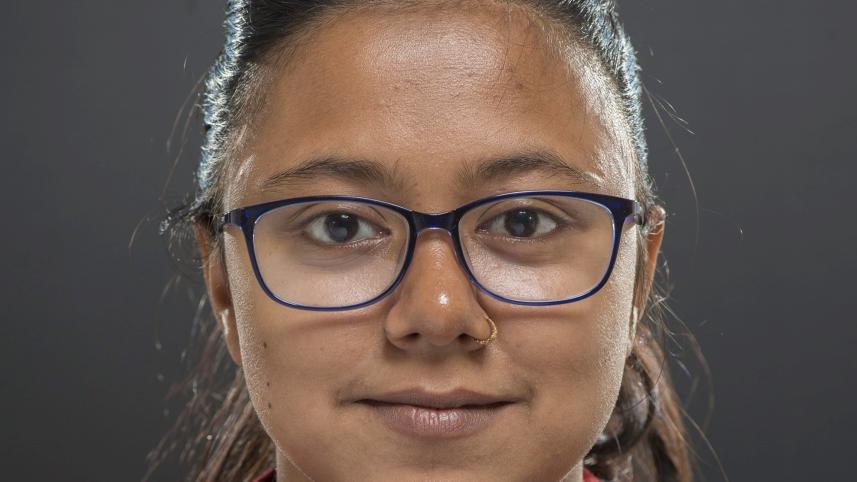
How often do we hear about Bangladeshi women in cinematography? In a field that is traditionally male dominated, Rawyan Shayema is on a journey to become a force to reckon with. In the American Film Institute (AFI), less than 1 percent of applications are accepted each year, and Rawyan is the first ever Bangladeshi to be accepted into the AFI.
Rawyan, a child from the suburbs of Rajshahi, was always fascinated by fiction. Losing her mother during her teenage years and being raised by her father in Dinajpur, Rawyan started developing an affinity towards films and cinematography.
 For all latest news, follow The Daily Star's Google News channel.
 I recently got the opportunity to talk to Rawyan, where the young filmmaker shared the story of her journey in filmmaking and how she got accepted into the AFI.
What made you fall in love with cinematography, and at what point did you decide to pursue it?
I love to read and I grew up in an environment that strengthened my bond with books, thanks to my father. After I had passed HSC, I got a chance in the public dental college. However, I knew my heart lay elsewhere. Over the years, my love for films pulled me towards cinematography and I decided to pursue it with all I had.
I convinced my father about my passion, and decided to pursue a degree in 'Film and Media' at Stamford University in 2011. Yes, directing is cool, writing stories is fun, but cinematography contains a massive realm of creativity which I dreamed about exploring.
Could you tell us about some of your favourite cinematographers, directors, or artists?
When it comes to indoor lighting, I strive to achieve the ambience of Rembrandt's paintings. As for outdoors, I try to portray nature the way Claude Monet did in his paintings. I did my bachelor's thesis on all the films of Alejandro Jodorowsky.
Emmanuel Lubezki's storytelling through indomitable and unique camera angles, and long takes attract me. I like Sir Roger Deakins for his diverse and colourful cinematography. The list of filmmakers I admire is endless. I love to watch the works of Andrei Tarkovsky, Abbas Kiarostami, Nuri Bilge Ceylan, Paolo Sorrentino, Wong Kar-Wai, Richard Linklater and all the great classic and contemporary artists.
Could you discuss some of your own work?
The first things we notice in any film or show are the acting, and the flow of the story conducted by the camera. The mood of the story directs the camera movement, framing, and lighting. Thus, I always attempt to capture the spirit of a story and let it guide my framing.
I have worked as a cinematographer, an editor, and a sound designer. I started my journey with two experimental short films "Story of a Couple" (2011), "Trap of Circle" (2011) in the first year of my undergrad. Till now, I have shot over 20 fiction projects and 80 percent of them I did for free. I received the best cinematographer award at the Stamford University Film Fest for "Burning Dust" (2013, directed by Saiful Islam Niloy) in 2014 which further ignited my passion.
I have also been awarded by Dhaka Doc Lab, DocSkool Nepal, Docedge Kolkata. My films have been featured in the Rotterdam Film Festival in the Netherlands, and Film South Asia Nepal.
What are some of the biggest challenges you have faced on your journey?
Being a woman in cinematography is difficult, particularly due to gender bias, social norms, and the lack of established female cinematographers in the fiction sector. It's disheartening when you see most women eventually shifting to other professions. I decided to make my own way and applied for an MFA in Cinematography to four prestigious colleges overseas and got accepted to all of them. I chose the American Film Institute as it's ranked as the number one film school in the world. Also, even though they provide a USD 20,000 partial scholarship, it's a herculean task to manage the remaining amount. That is why I am raising funds via GoFundMe for the rest of my tuition and expenses.
How do you plan on contributing to the field of cinematography, both locally and internationally?
The AFI has nurtured almost 30 Oscar winners, and 149 nominees. I will be carrying the flag of my country as the first Bangladeshi woman to be accepted into the AFI. As part of my studio courses, I will be working under renowned Hollywood filmmakers. I can then come back and pass on my learning to the next generation of cinematographers in Bangladesh. Moreover, I'd be open to work with our local directors.
Comments