


Govt cuts 700 MHz spectrum price by 10%
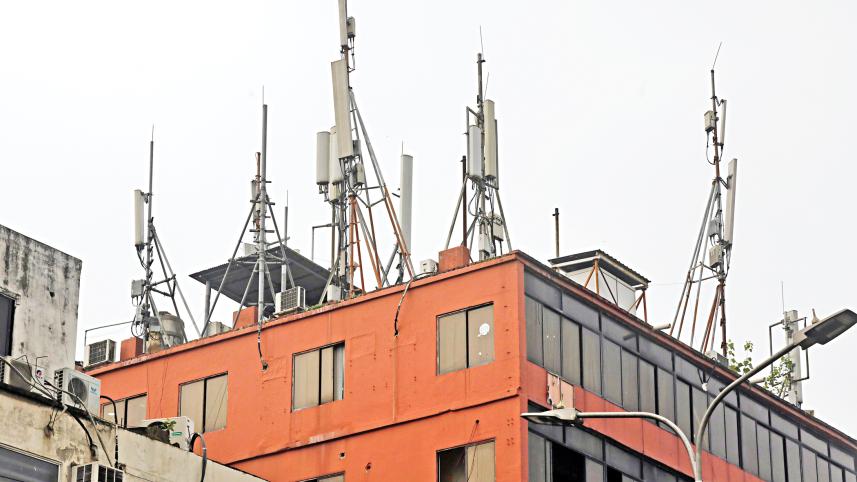
The government has approved a 10 percent reduction in the price of the 700 MHz frequency band, often called the "golden spectrum" for mobile networks, as the Bangladesh Telecommunication Regulatory Commission (BTRC) prepares for an auction.
The move is aimed at expanding mobile coverage and improving service quality nationwide.
 For all latest news, follow The Daily Star's Google News channel.
 "We received approval from the ministry on Tuesday," said Major General (retd) Md Emdad ul Bari, chairman of the BTRC. "Preparations for the auction have already begun."
The Finance Division formally approved the reduction, which aligns with global trends where the cost of similar spectrum bands has fallen sharply. According to GSMA, an international mobile industry body, prices for frequencies below 1 GHz have dropped about 75 percent between 2012 and 2023.
After the 10 percent reduction, the base price of 700 MHz spectrum is set at Tk 237 crore per MHz for a 15-year allocation, down from Tk 263 crore per MHz
AUCTION AND PRICE DETAILS
BTRC documents show that after the 10 percent reduction, the base price of 700 MHz spectrum is set at Tk 237 crore per MHz for a 15-year allocation, down from Tk 263 crore per MHz.
Faiz Ahmad Taiyeb, special assistant to the chief adviser for telecom and ICT, said the government had earlier directed the BTRC to lower the spectrum price following requests from global telecom investors.
He explained that under the country's telecom policy, operators could receive an additional 20 percent discount if they meet network rollout targets within the first two years.
Taiyeb also noted that the government plans to allow payment of spectrum charges from the second year, giving operators time to establish their network infrastructure before financial obligations begin.
The upcoming auction will cover 25 MHz of the 45 MHz spectrum designated for mobile use. The remaining 20 MHz is tied up in a legal dispute dating back to 2007, when BTRC allocated 12 MHz of the band to broadband provider Always On Network Bangladesh Ltd before it was approved for mobile services.
The allocation was later declared invalid, but the case is pending in the Supreme Court. Once the dispute is resolved, the government plans to reserve 10 MHz for state-owned Teletalk.
Operators will need to pay a non-refundable application fee of Tk 15 lakh and a bid deposit of Tk 10 crore. The 25 MHz will be offered in five blocks, and the auction is scheduled for January 14, 2026, according to BTRC's instructions.
THE GOLDEN SPECTRUM
Spectrum is a range of electromagnetic frequencies that telecom companies use to send mobile calls, internet data, and other wireless signals. Different frequency ranges are called bands, and each has unique properties.
For instance, low-band frequencies, like 700 MHz, travel farther and pass through walls and buildings more easily. High-band frequencies can carry more data but have shorter range and are easily blocked by obstacles.
The 700 MHz band is prized worldwide as the "golden spectrum" because it combines long-range coverage, strong indoor signals, and relatively low network deployment costs. This makes it ideal for both rural and urban areas and accelerates the rollout of 4G and 5G services.
OPERATORS NOT HAPPY
Mobile operators have expressed concerns over the limited spectrum and the relatively small discount.
Taimur Rahman, chief corporate and regulatory affairs officer of Banglalink, the country's third-largest operator, called the 700 MHz band a "digital dividend" that should be affordable for all operators.
"Adequate spectrum has to be ensured so that all can get it. But with only 25 MHz, that may be difficult. Besides, there needs to be a cap on how much spectrum one operator can procure, particularly for the bigger operators," he added.
Shahed Alam, chief corporate and regulatory officer of Robi Axiata, the second-largest operator, said the proposed 10-20 percent discount is insufficient and largely symbolic, given the high cost of deploying 700 MHz.
"The pricing methodology is flawed. It wrongly pegs 700 MHz rates to older 900 MHz prices. This ignores the reality that 900 MHz is supported by nearly all handsets, whereas only around 60 percent support 700 MHz today," he said.
"Deploying 700 MHz isn't a simple extension of existing networks," Alam said. "It requires building a new network layer, which involves significant investment in infrastructure and ecosystem readiness."
Limiting access to the full 45 MHz band could create market imbalances and harm competition, he also noted. "Unless spectrum pricing reflects current market realities and deployment challenges, these measures will strain operators and ultimately impact affordability for consumers."
Comments