


India moves to boost textile competitiveness against Bangladesh, Vietnam and China

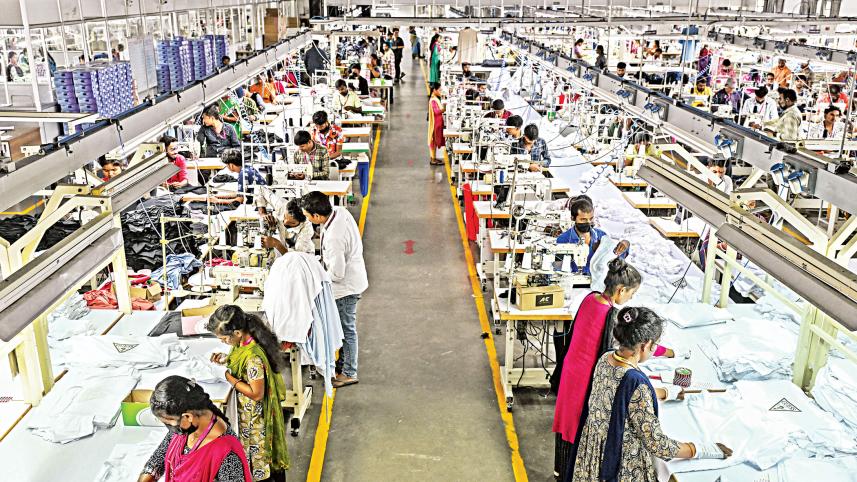
Faced with a 50 percent tariff imposed by the United States, the Indian government has drawn up a four-point action plan with three separate timeframes to regain cost competitiveness in the global textile market, with a particular focus on competing with Bangladesh, Vietnam, and China.
Ranked as the world's sixth-largest textile exporter, India has long trailed its regional rivals in export growth. The new roadmap, drafted by the Indian Ministry of Textiles, seeks to reverse that trend through structural reforms designed to strengthen competitiveness and expand exports to $100 billion by 2030.
 For all latest news, follow The Daily Star's Google News channel.
 According to a ministry note shared with industry stakeholders, the plan outlines three phases: short-term (two years), medium-term (five years), and long-term (open-ended). It aims to scrutinise the overall cost structure of the sector, including raw material prices, taxation, production costs, labour regulations, and environmental standards.
Four committees comprising textile sector representatives have been formed to deliver time-bound recommendations in four key areas: strategies for new markets; fiscal and ease-of-doing-business measures; structural reforms in the textile value chain; and enhancing cost competitiveness in selected products.
The ministry acknowledges that India's textile competitiveness has eroded in recent years as Bangladesh and Vietnam have gained ground through lower production costs, skilled labour, and modern manufacturing technologies. These advantages have made them formidable competitors for India, particularly in ready-made garments (RMG).
"Labour productivity in India's textile industry remains 20 to 40 percent lower than in its closest competitors, underscoring the urgency for reform," said Shiraz Askari, president of Apollo Fashion International.
India's share in the global textiles and apparel market stood at 4.1 percent in 2024. The sector, including handicrafts, contributed 8.63 percent to the country's total merchandise exports in fiscal year (FY) 2024-25, valued at $37.7 billion.
While the United States remains India's largest export destination, accounting for 28.97 percent of textile and apparel exports, it represents only about 6 percent of the overall Indian textile industry, which is valued at $179 billion — $142 billion domestic market and $37 billion exports.
The roadmap also places emphasis on India's 15 existing Free Trade Agreements (FTAs) with countries that collectively import $198.9 billion worth of textiles annually. The South Asian country is currently in advanced talks to sign an FTA with the European Union, whose combined textile import market is estimated at $268.8 billion — more than twice the size of the US market.
Provisional data from the Directorate General of Commercial Intelligence and Statistics (DGCIS) show India's textile exports reached $3.10 billion in July 2025, marking a 5.37 percent year-on-year rise from $2.94 billion a year earlier. For April-July 2025, cumulative exports stood at $12.18 billion, up 3.87 percent year-on-year.
RMG exports rose to $1.34 billion in July 2025, up 4.75 percent, while cotton textiles — including yarn, fabrics, made-ups, and handlooms — reached $1.02 billion, up 5.17 percent year-on-year.
In contrast, the US imported $107.7 billion worth of textiles in 2024, up 3 percent from the previous year. China accounted for 21 percent of those imports, followed by Vietnam at 19 percent, Bangladesh at 9 percent, India at 6 percent, and Sri Lanka at 3 percent.
Askari said India's textile industry must focus on improving efficiency, strengthening compliance, and diversifying export destinations to reduce overdependence on any single market.
The textile ministry's note highlights that Bangladesh and Vietnam enjoy higher labour productivity, more flexible labour laws, and duty-free access to raw materials and key export markets, including Europe. Vietnam also benefits from duty-free access to the Chinese market, further boosting its competitiveness.
Comments