


Manipuri weavers stare at bleak future

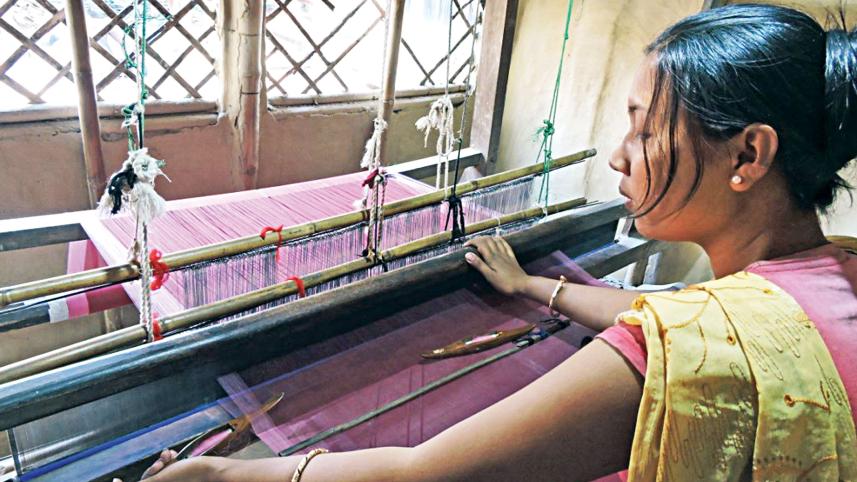
Weavers and clothing entrepreneurs in Kamalganj upazila of Moulvibazar usually take on loans to make Manipuri clothing items as they get ready for higher sales ahead of Eid festivals.
The same had happened in the weeks before the last two Eid festivals this year. But despite easing off coronavirus restrictions ahead of the big occasions, they were left in despair as sales did not pick up.
 For all latest news, follow The Daily Star's Google News channel.
 This means the weavers and clothing wholesalers, and retailers have been deprived of robust sales for the last four Eid festivals in a row owing to the lockdowns and pandemic-induced economic slowdown.
"Now, we will have to sell clothes at a much lower price than the fair price to pay monthly instalments on loans and earn a living. Still, there are no buyers," said Sima Singha, a weaving entrepreneur in Kamalganj.
All the Manipuri weavers in the Sylhet region are facing the same plight.
During a visit to Adampur and Madhabpur area in Kamalganj and Radhanagar area in Sreemangal upazila in Moulvibazar last month, almost half of the clothing shops in the local markets were found to be closed, although curbs were relaxed owing to the Eid festival.
Sales hit rock-bottom in the outlets that were open. Now weavers fear losing all the investment.
Manipuri is an indigenous community that carries on a uniquely exquisite art of weaving, which is also their bread and butter and has been passed down from generation to generation.
Manipuri saris, shawls, scarves and salwar kameezes and bedsheets are a few of the merchandise that are high in demand.
Since sales peak during Eid festivals, the Manipuris invest their savings in making new merchandise ahead of the two occasions.
"But the pandemic has inflicted a huge loss," said Rabi Singha Rajesh, member secretary of the Manipuri Cultural Academy Bangladesh.
According to local traders, Manipuri cloth is an attractive product to domestic and foreign tourists visiting Moulvibazar.
More than 10,000 domestic and foreign tourists used to travel to the area every day before the pandemic. But since the virus arrived on the shores of the country, domestic and foreign tourists have not been seen.
In Sylhet city, there are more than 100 wholesale stores that sell Manipuri items. The largest wholesale market is located in Bandarbazar area. Many wholesale stores have also been set up in Lamabazar, Zindabazar, Tilaghar, Chowhatta, and Ambarkhana.
Many Manipuris also sell their merchandise directly from their houses in Lamabazar and Mashimpur in Sylhet city and Kamalganj and Sreemangal upazilas.
Saddam Hossain, a trader in Sreemangal, says these markets usually attract a lot of shoppers during normal times.
"But this time, there were only a few people around, and not much noticeable business transaction is taking place at the handful of stores that are open," he said ahead of Eid-ul-Azha.
Mithun Singha, a clothing trader from Sreemangal's Radhanagar area, has a wholesale store in the main business centre in the upazila. He has not been able to sell any of the clothes in the past few months.
"But the store rent, electricity bills and other expenses kept piling up. So, I had to shut the store this month."
Shilpi Devi, a weaver in Adampur, says Manipuri saris are popular among young women, including the newlyweds. But lately, sales have been poor.
"Wholesale buyers are not turning up. So, I'm selling the items at lower prices to any customer I can find," said Ranjita Debi, a weaver in Lamabazar.
"With sales falling almost to zero, we are now in a crisis."
Lakshmikanta Singh, executive director of the Ethnic Community Development Organisation (ECDO), an NGO, says weavers meet at least 15 per cent of the local demand for clothes.
Around 5 per cent of the total production is exported to the UK and the US.
He says wholesalers from different districts, including Dhaka, Chattogram, Narsingdi and Bogura, used to come and place orders for bulk quantities.
"But this time, they were unable to come to the town due to the lockdowns."
The NGO opened an outlet, Moirang, for Manipuri women handloom artists in 2014. It has been shut during the pandemic.
It requested customers to buy clothes online, but the response has been low.
Some Manipuri women used to work in the factory of the NGO, but they could not regularly come for the last one and a half years due to the lockdowns.
"As a result, the production has come to a halt. We are at a loss now," Lakshmikanta Singh said.
Many weavers say the industry has suffered a lot during the pandemic. Many have become unemployed.
But so far, there has been no major support from the government although state assistance is essential for the survival of the industry, they say.
Kamalganj Upazila Nirbahi Officer Ashekul Haque said: "A list has been prepared. They will be assisted very soon."
Barkat Ullah, liaison officer of the Bangladesh Handloom Board (BHB) in Kamalganj, says considering the present scenario, the board has cut the interest rate on loans for Manipuri weavers to 5 per cent from 10 per cent.
The loan repayment period has also been extended and conditions relaxed. A weaver can borrow a maximum of Tk 2 lakh.
So far, the BHB has disbursed Tk 1.70 crore among 1,274 weavers in the division, home to about 3,000 Manipuri weavers.
"We have sent a list of the people who have marginalised by the pandemic to the senior officials of the board."
"I have also sought relief from the local administration, which has assured us of providing support. We will receive the relief within a couple of days."
Comments