


Govt sends reform proposals to WB to get budget support


The government will set up an apex body to help complete large projects as part of a raft of policy reforms for getting budgetary support from the World Bank.
A finance ministry official said the ministry has sent a set of policy reforms to the WB recently, covering nine areas such as public fund management, banking, energy, transport, ICT, public private partnership and migrant workers.
 For all latest news, follow The Daily Star's Google News channel.
 Budgetary support and other issues will be discussed at a meeting between AMA Muhith, finance minister, and Annette Dixon, vice president of the World Bank for its South Asia region, in Dhaka today, said the official.
The WB is currently reviewing the reform proposals; it will be finalised once the anti-poverty lender gives its opinions.
If the WB is happy with the set of proposals, it will be forwarded to the bank's headquarters for approval, said the finance ministry official.
The WB's budget support is the aid that is channelled directly to a country's budget on condition that the government would implement a number of reforms.
The reforms will be implemented in three years, starting in fiscal 2015-16.
In the transport sector, the government will form an apex body to coordinate activities of various government agencies in Dhaka to successfully complete the large ongoing projects in the first year of the three-year reform period. It will also prepare an urban transport policy.
In the second year, the metro rail law will be placed before parliament. It will also prepare an action plan to operationalise Dhaka Transport Coordination Authority to effectively implement the strategic transport plan. The action plan will be approved and operationalised in the final year.
“The proposed reforms in the transport sector will help successful completion of various mega projects and ensure transport discipline and reduce traffic congestion,” according to the government's reform proposals.
In the financial sector, the government will prepare and update a time-bound action plan in the first year to strengthen the state-owned commercial banks, particularly improving governance, human resources, risk management capacities and internal control.
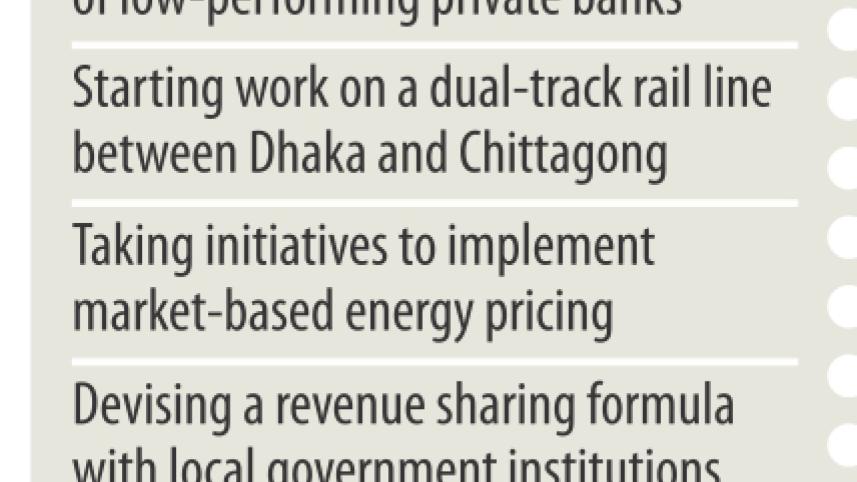
In the second year, it will approve the action plan and initiate the reforms as well as prepare a diagnostic report of low-performing private banks.
In the third year or 2017-18, authorities will prepare a draft guideline on banking norms for commercial banks.
The government will prepare a revised public fund management (PFM) strategy in 2015-16. In the second year it will develop an integrated ICT solution for PFM, foster budget integration and strengthen the medium-term budgetary framework.
It will promote institutional change in external statutory audit, increase transparency of the budget and design new modalities to support strengthening of PFM.
Also in 2015-16, the government will prepare a strategy paper to pave the way for devising a revenue sharing formula with local government institutions that are cash-strapped, and have little revenue raising authority and limited control on government departments at local levels.
It will also work to transform local bodies into effective institutions. In the following two fiscal years, the government will prepare a roadmap based on the recommendations of the strategy paper, and approve and initiate implementation of the roadmap.
In the energy sector, the government will revise the Power Sector Master Plan and prepare an Energy Efficiency and Conservation Master Plan in 2015-16, which will be approved in the following year.
Also in 2015-16, it will prepare a strategy aimed at increasing efficiency of existing thermal generation plants, diversifying generation of fuel mix to enhance energy security and taking initiatives to implement market-based pricing.
In the second year, the government will form the Bangladesh Energy Research Council to conduct research and development work in the power and energy sector. It will also revise the energy policy, which will be approved in 2017-18.
The government will place the draft law on the public private partnership (PPP) framework at parliament in the first year. In the second year, it will formulate rules to operationalise the PPP law. The reforms are aimed at encouraging the private sector to undertake more PPP projects.
In the ICT sector, the National Telecommunication Policy 1998 and Bangladesh Telecommunication Regulatory Act 2001 will be updated in the first year.
The government will formulate a spectrum roadmap as well as draft licensing guidelines in the second year. The policies, laws, roadmaps and guidelines will be approved in the third year to help the sector leap forward.
The government will finalise and approve a draft action plan to enhance the economy's integration with regional and global markets in 2015-16.
In the second year, a comprehensive national logistics strategy will be prepared.
The government will also start work on dual tracks for the main rail line between Dhaka and Chittagong to increase the movement of containerised cargo in the second year.
It will also set up a rail inland container depot in Tongi with a capacity of 150,000 twenty-foot equivalent units with financial assistance from the Asian Development Bank in the same year.
The government will also work with India and Myanmar to improve efficiency of common border posts.
For the migrant workers, it will prepare a strategy in the first year to reduce the cost of remittance they send home, which will be followed by new measures to do the same in the second year.
Comments