


Environment & Changing Climate conference held at IUB
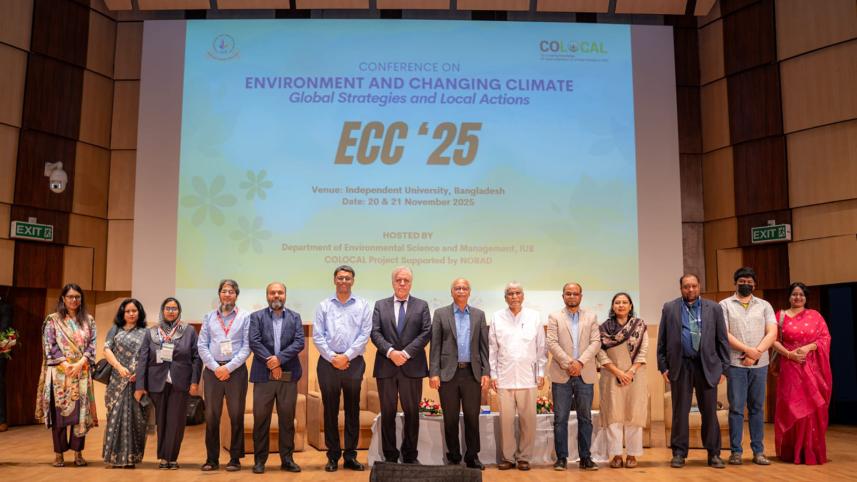
The Environment & Changing Climate 2025 conference at Independent University, Bangladesh ended on November 21, after two days of discussions on inclusive climate action. The event was organised with the COLOCAL project.
Beginning on November 20, the conference brought together national and international researchers, development practitioners and community leaders under the theme "Global Strategies and Local Actions." Participants discussed community-led and context-specific approaches to climate adaptation.
 For all latest news, follow The Daily Star's Google News channel.
 Day one featured keynote speeches by Dr A Atiq Rahman, Dr Shahpar Selim and Dr Faisal Kabir. IUB Vice Chancellor Prof M Tamim, Pro Vice Chancellor Prof Daniel W Lund and Dr K Ayaz Rabbani also spoke. Rupantar Theatre performed a potgaan on climate justice and gender equity. Muiz Mahfuz Band performed songs about plastic pollution and the environment. The day ended with an alumni roundtable focused on the climate change and development sector.
Day two featured oral and poster presentations covering climate governance, indigenous knowledge, agriculture, energy transitions and related areas. Workshops and side events supported discussions on locally led adaptation.
NGO leaders from Dalit and Munda communities in Khulna and Satkhira spoke about their experiences with nature-based solutions. A session by CIMMYT, Shushilan and ICCCAD discussed tools for locally led adaptation. COLOCAL fellows from Bangladesh and Uganda shared their research. Nirmol Bangladesh held a workshop on ocean literacy.
Youth engagement was a strong element throughout the programme. INFLUENCERS hosted a session on youth-led climate advocacy. Hong Kong University of Science and Technology held a session on its public policy programmes on climate and governance.
The conference received partial support from the COLOCAL Project, funded by the Norwegian Agency for Development Cooperation. The project works to strengthen research and education on climate adaptation in Bangladesh, Nepal, Uganda and Mozambique.
Comments