


Disposal of graft cases loses steam
The recent surge of activity by the Anti-Corruption Commission seems to have less impact on curbing corruption, with an increase in pending cases due to legal tangles.
Graft cases have piled up over the years as the special courts that deal with them have been giving more emphasis on criminal cases since the enactment of the Special Court (Additional Charge) Act, 2003, said ACC Director General (Legal and Prosecution) Moyeedul Islam.
 For all latest news, follow The Daily Star's Google News channel.
 “Due to the piling up of [graft] cases it is taking long to punish corrupt people, which causes frustration among justice seekers,” said TIB Executive Director Dr Iftekharuzzaman.
The rate of case disposal was high before the government passed the act since the courts were handling graft cases only at the time.
Identifying the problems, the anti-graft body wrote to the law ministry and the registrar general of the Supreme Court on September 8 for quick disposal of graft cases.
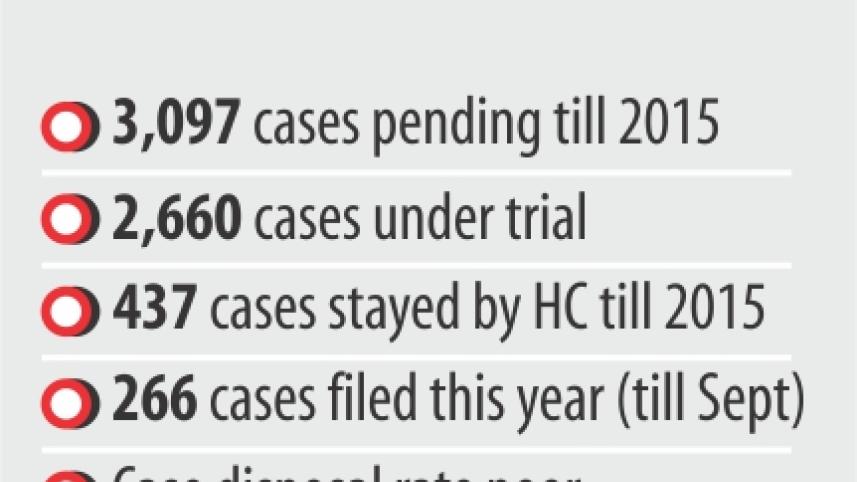
Until last year, the number of pending cases filed by the ACC was 3,097, of which Hallmark loan scam, BASIC Bank loan scam and Destiny and Bismillah groups' money laundering cases drew much attention.
Of the 3,097 cases, 2,660 were under trial and 437 remained stayed by the High Court on different grounds, according to the ACC's annual report of 2015.
Another 266 cases have been added to the lot until September this year.
Apart from these cases, the ACC has to investigate and gather evidence in cases filed during the time of the anti-corruption bureau defunct 12 years ago. The number of pending cases of the bureau regime until last year was 1,080.
Another setback for the anti-graft body is that not all 32 special judges' courts, including 13 in Dhaka, are fully functional.
The trial proceedings at seven out of 10 special courts created during the army-backed caretaker government have been suffering for not having stenographers, court sources said. These courts hire stenographers from others to function.
There are instances that some of these tribunals didn't dispose a single case in a year, said the ACC director general.
Against these backdrops, those accused of corruption go about their lives as usual without worrying about punishment, which raises questions about the effectiveness of the ACC.
For example, a Tk-7.37 crore misappropriation case was filed against high-ups of the coastguard in 1998.
Eighteen years have gone, but the case filed by the defunct bureau is yet to see trial because of a writ filed that year.
In August this year, the HC vacated the writ, which was followed by the arrest of the then director general and a director of the coastguard. Now the ACC has to complete a probe and then file a charge-sheet for the trial to begin.
The ACC's activities got momentum in 2007-08 during the caretaker government when a total of 1,680 FIR (first information report) was filed with different police stations and charge sheets were submitted in 567 cases.
At the end of the caretaker government's rule in 2009, the number of pending cases stood at 780.
Between 2009 and 2015, the ACC got verdicts in 2,025 cases.
“On many occasions, we've seen that both the High Court and special courts delayed judgments. They fix a date for judgment and defer it on the day of delivering the verdict,” Moyeedul said.
A high official of the law ministry admitted it.
The ACC has asked the authorities concerned to relieve the special courts of additional duties, Moyeedul said, meaning that they would only hold the proceedings of graft cases.
The ACC requested the law ministry to direct the session judges' courts of the districts to transfer graft cases directly to the special courts.
“We have also asked for keeping a record of the special judges' courts quarterly, half-yearly or yearly to check how many cases they have disposed of,” said the ACC official.
Meanwhile, the law ministry official preferring not to be named said the ministry took the legal barriers seriously and so was working on to amend the 2003 act.
“Once it is amended, the special courts will only conduct [trial of] graft cases,” he said.
Iftekharuzzaman of the TIB said all stakeholders should work together to fight corruption effectively and suggested that the ACC create a priority list of cases to work on.
Comments