


World Tuberculosis Day: Tea workers exposed to TB

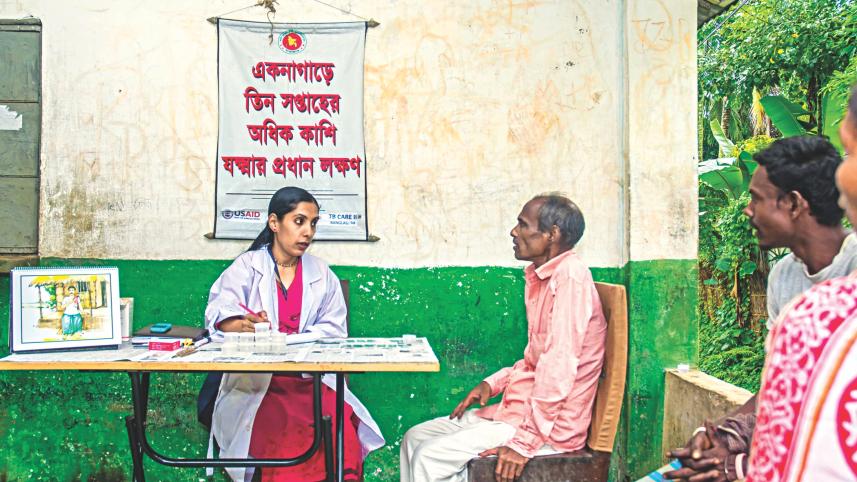
Thirteen-year-old orphan Supra Bawri's lives with her grandparents on the Jagchara tea estate in Sreemangal upazila of Moulvibazar.
Last year, suffering from a mild cough for three weeks, Supra then developed a dry, itchy cough and began to lose weight rapidly.
 For all latest news, follow The Daily Star's Google News channel.
 "At first, we didn't believe that Supra was seriously ill," said Supra's grandfather Nitai Bawri, adding that they didn't start buying the necessary medicine because of fear of the social stigma and discrimination TB patients and their families face.
"Later, I took her for treatment when she became very weak."
The family lives in a one-room house with no ventilation or drainage, which they share with their domesticated animals. Many tea workers still live in basic mud houses.
"We have eight families in six houses in a small space, and these eight families have 34 members in total. We live together with our cows and goats," said 45-year-old Santosh Rally, a female tea worker at Shamshernagar tea garden in Kamalganj upazila of Moulvibazar.
In such cramped living quarters, it is easy for contagious diseases such as TB to spread.
Densely populated living quarters, malnutrition, lack of awareness, unhygienic living conditions, and weak immunity all compound in a relatively high incidence of TB among these workers.
Countrywide, 221 out of every 100,000 people suffer from TB; among tea garden workers in Sylhet division, this figure is over 433.
TB is caused by bacteria called Mycobacterium tuberculosis, which usually attacks the lungs, but can also damage other parts of the body. Many cases do not show symptoms and those with a weak immune system are more likely to get TB. If left untreated, TB can be fatal.
Dr Tauhid Ahmed, civil surgeon of Moulvibazar, said the district has a greater prevalence of tuberculosis. "Therefore, cough examination and treatment are given special importance in hospitals."
A total 3,251 tea garden workers were found infected with tuberculosis among 23,185 presumptive examined in 16 upazilas of Sylhet, Habiganj, and Moulvibazar last year, said Munuru Jacob, project director of Challenge TB under HEED Bangladesh, which works with the cooperation of the Global Fund for Aids, TB, and Malaria.
In 2018, 2,933 tea gardens workers with TB were found among 20,428 presumptive examined; the figures in 2017 and 2016 were 2,233 and 1,382 respectively.
Forty-year-old pregnant tea worker Sanjha Tanti at Hossainabad tea garden in Sreemangal said she works from morning to 5:00pm.
"When I need to use the toilet, I have to do it in the open as there is no latrine in the tea garden section." Afterwards, she has to use water from the dirty canals running through the tea garden.
This is common for all workers in tea gardens, said Sitaram Bin, a union parishad member of the Shamshernagar tea garden. A combination of poor nutrition, lack of awareness of hygiene, and an unclean living and working environment means these workers' immune systems are comparatively weaker and makes TB more likely to spread among workers, he added.
"TB is more prevalent in the tea gardens area. We are taking initiatives to raise awareness among the workers," said Dr Premananda Mandal, civil surgeon of Sylhet.
The Challenge TB project covers 184 tea gardens in 16 upazilas in three districts under Sylhet division.
"The number of TB affected tea garden workers is high because these workers cannot meet their basic needs as their daily wages amount to only Tk 102," he added.
Shah Alam, chairman of Bangladesh Cha Sangshad, the tea garden owners' association, told this correspondent Heed Bangladesh is responsible for undertaking various measures for TB-affected tea workers. "It is Heed Bangladesh's negligence," he said.
Heed Bangladesh is implementing Tb control programme for 16 upazilas in three districts under Sylhet division in collaboration with the government.
Munuru Jacob of the organisation said the organisation follows up on each TB patient at every stage for 28 days. "Further follow-up in improving living and working conditions is important and depends on the tea gardens' management."
Comments