


Commuters in a tight spot
It was midday; lost in thoughts, Mizanur Rahman was sitting inside his electronics store.
When this correspondent walked inside, considering him a potential customer, the owner of Elahi Electronics got up.
 For all latest news, follow The Daily Star's Google News channel.
 But soon he flinched.
After an initial hesitation, Mizanur said, “Our business is declining due to a poor presence of customers after the transport restriction in the Gulshan area.”
“I have been doing business here for the last 12 years. Before, we hardly got time for lunch,” the 45-year-old looked around and sighed.
Since the terror attack at a Gulshan eatery last July, the law enforcement agency imposed a restriction on the movement of buses that once operated between Kakoli and Natun Bazar.
“On top of the increased transportation cost, a buyer will have to change a bus or rickshaw at least twice to buy goods from here. Why would they come here?” Mizanur said. He said his monthly profit dropped to Tk 10,000 from Tk 40,000.
Meanwhile, commuters are the worst sufferers of the restriction in Gulshan, which encompasses residential, commercial and diplomatic zones. Not only local businesses, transport owners are also incurring losses.
Local societies, which have been trying to launch a new bus service for a long time, introduced Dhaka Chaka, an air-conditioned (AC) bus service under the coordination of Dhaka North City Corporation (DNCC), which operates within Gulshan, Banani and Niketon areas.
The bus operates from Gulshan-2 to Niketon and Kakoli to Natun Bazar.
One has to change buses twice -- get off at Gulshan- 2, then get on another one -- while travelling from Gulshan-1 to Kakoli, which is 3km, and for the entire trip a commuter has to pay Tk 30. Earlier, it took Tk 10 to travel the distance.
“People from the nearby locality used to come here for services like photocopy or printing. Now, you tell me, who will come for that spending Tk 30?” said KM Nuruzzaman, manager of a stationary shop on Madani Avenue.
Meanwhile, MA Malak, senior vice-president of DNCC Gulshan-2 Kitchen Market, alleged they have raised the issue before the mayor several times, but got no response.
Sohel Rana, an undergraduate student of a private university, lives in Kachukhet, and uses the 36-seater AC bus regularly. “I go through a bizarre experience of cold and hot temperature every day as I am forced to change buses twice. I don't see any benefit; only it increased my transportation cost.”
“If I use the bus, I will have to pay Tk 30 every day,” said Mamun Mia, a security guard at Labaid Hospital in Gulshan-2, adding, “If I have to pay Tk 900 for transportation every month, how can I run my family with my Tk 6,000 salary?”
The Natun Bazar resident said earlier his monthly transportation expenditure was about Tk 300.
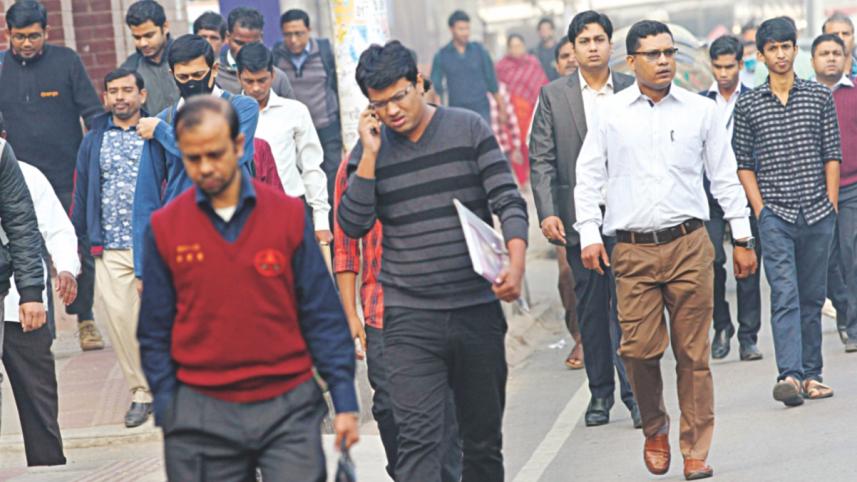
Due to the restriction and transportation crisis, students, office-goers and day labourers walking towards their destinations has become a regular phenomenon in Gulshan and Banani areas.
Md Shahadat, a salesperson at United Pharma, said now he walks to work at Gulshan-2 from Natun Bazar. “It takes half the time since I do not have to wait for a bus or get stuck in a traffic jam,” he said.
Though the authorities have taken the initiative over security concerns, the restriction also paved way for illegal auto-rickshaws making a quick buck. Most of these CNG-run auto-rickshaws do not have meters but are carrying passengers under the nose of the on-duty police officers.
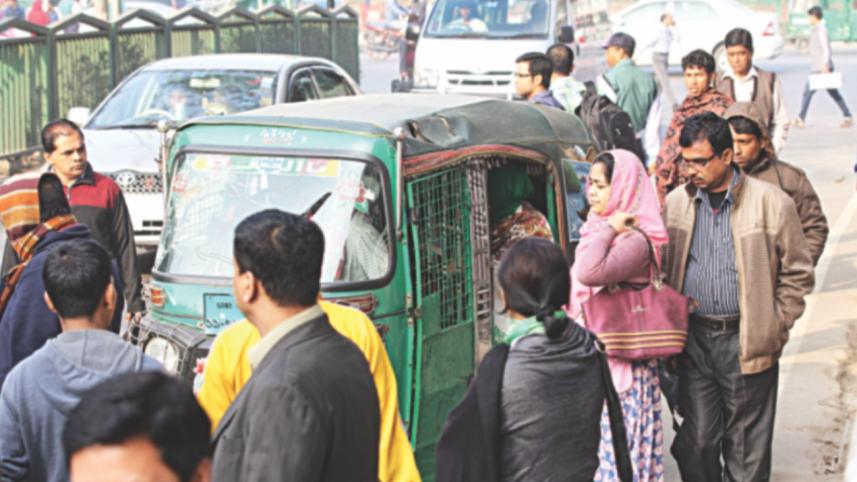
“Before the incident [Holey Artisan attack], police often bothered us. Now they don't say anything due to the transport crisis,” said Idris Mia, a CNG-run auto-rickshaw driver.
The local authorities not only imposed restrictions on the regular buses, rickshaws are also off-limits in the Gulshan and Baridhara areas, which has impeded smooth movement of the commuters.
Often, rickshaw-vans used for carrying schoolchildren are seen transporting passengers in between school hours.
Also, the traffic pressure between Madhya Badda and the Mohakhali Amtala turn has increased as additional buses were added to the already overcrowded route.
“In a word, we're facing losses. Congestion on the road [Madhya Badda to Mohakhali turn] has increased, resulting in fewer numbers of trips,” said Md Nasir, a driver of Robrob Paribahan.
The number of passengers also declined due to the additional buses plying the road, he said.
The restriction has also contributed to gridlock on Bir Uttam AK Khandakar Road as the buses that earlier plied Madani Avenue had to divert their routes, resulting in transport owners facing losses, said the owners.
“Now, we travel from Madhya Badda to Mohakhali via Gulshan-1. Before, we used to go through Kakoli to Natun Bazar via Gulshan-2,” said Shalauddin Rony, one of the owners of Bihanga Paribahan.
He said their monthly turnover has dropped to Tk 25,000, and to cope up with the situation many owners had to reschedule their bank loans.
BRTA Director (engineer) Nurul Islam said a committee comprising bus owners and BRTA officials has been formed to fix the fare of the AC service. “The committee is scrutinising the fare,” he said.
Contacted, DNCC Mayor Annisul Huq said, “Traffic jams have no grammar. It varies. We're working to repair the roads, which will take another one or two months. After that, the congestion will reduce in Gulshan,” he said.
Cheaper bus service can be introduced, he said, adding, “But it depends on Dhaka Metropolitan Police (DMP) since they've stopped the regular bus service on security grounds.”
“We're planning to introduce small transports in Banani and increase the numbers of Dhaka Chaka for smooth communications,” said Deputy Commissioner (Gulshan zone) Mostaque Ahamed.
Regarding the traffic jam at Gulshan-1, he said, “Inform it to the traffic department, once they give us their observations, we'll address the issue.”
He said they have also asked the traffic department of police to take action against the illegal auto-rickshaws plying the area.
Comments