


Labour market in Malaysia: Strict conditions raise fear of syndication

The criteria Malaysia has set for selecting Bangladeshi recruiting agencies for a fresh round of labour intake have stirred concern among experts, industry insiders, and government officials, who fear the conditions could concentrate power in the hands of a few large agencies.
They said that seven of the 10 conditions Malaysia sent to Bangladesh on October 27 can be met by many among the more than 2,000 licensed agencies.
 For all latest news, follow The Daily Star's Google News channel.
 These include having a valid licence for five years, experience of sending workers to at least three countries in that period, a certificate of good conduct, no record of forced labour, trafficking, extortion, money laundering or labour-law breaches, and five written testimonials from employers.
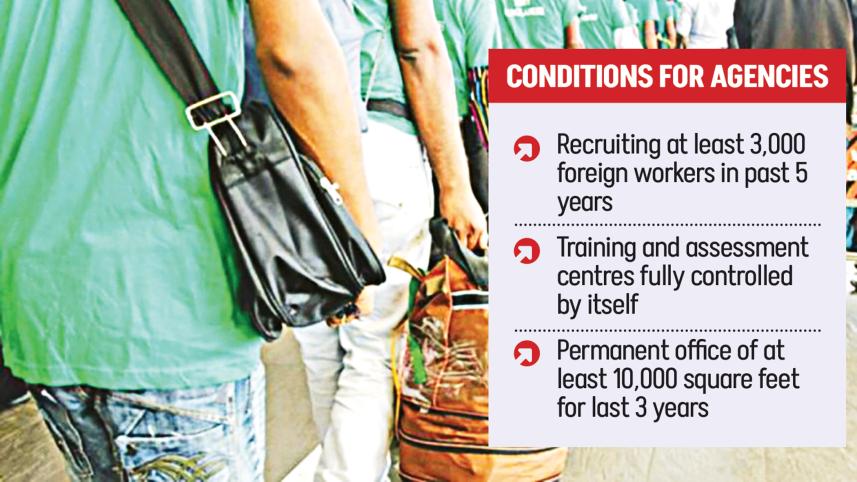
It is the remaining three conditions that are seen as prohibitive -- a record of recruiting at least 3,000 foreign workers in the past five years; training and assessment centres fully controlled by itself; and a permanent office of at least 10,000 square feet for the last three years.
The government, recruiting agencies, and migration researchers say these requirements are impractical.
Speaking yesterday after inaugurating the "Overseas Employment Platform" at a Dhaka hotel, Expatriates' Welfare and Overseas Employment Adviser Asif Nazrul said several of the conditions were unacceptable.
Bangladesh, he said, had already conveyed its objections and would continue talks with Malaysian authorities to secure "a more favourable position for Bangladeshi workers".
"Only a handful of agencies would be able to send workers if these standards are enforced. We want an open and competitive labour market," he added.
The expatriates' welfare ministry has formally asked Malaysia to review the three contentious conditions.
Malaysia had initially sought a list of compliant agencies by November 15 but extended the deadline after Dhaka requested more time.
An official at the ministry told The Daily Star on November 15, "We think these were difficult to fulfill by our recruiting agencies. However, we also asked the licensed recruiting companies to submit applications."
About 1,000 agencies applied and the ministry shortlisted roughly 500, officials said. After further scrutiny, a final list will be sent to Malaysia.
However, officials acknowledge that "hardly a few agencies" could truly meet all 10 Malaysian conditions. "Therefore, we have asked the Malaysian government to relax the three criteria," one official said.
At least 10 agencies wrote to Adviser Asif Nazrul on October 30, opposing Malaysia's criteria outright.
"I don't think any of the Bangladeshi recruiting agencies can fulfill the three criteria. These are also not important at all," said Mohammad Fakhrul Alam, former joint secretary of Bangladesh Association of International Recruiting Agencies (BAIRA), and one of the signatories to the agencies' letter.
He said the demand for a 10,000 sq ft office and fully controlled training centres would only inflate recruitment costs, which had already soared to Tk 450,000–600,000 between 2022 and 2024.
It was "totally unnecessary" to require such office space and training centres when Malaysia itself does not mandate specific training, he said.
The letter from the 10 agencies argues that most local recruiters would fail to meet the requirement of sending at least 3,000 workers in the past five years due to disruptions caused by the Russia-Ukraine war, the global economic downturn, long-running syndication in the Malaysian labour market, and the closure of labour channels by the UAE, Bahrain, Qatar, Oman and Libya.
Migration researchers and industry insiders say Bangladesh's past experiences with Malaysia are fraught.
During 2022–24, a syndicate of 101 agencies, handpicked by Malaysia, operated under the influence of two powerful business figures, one based in each country.
The same leaders were behind the syndicates that controlled recruitment during 2016–18. Malaysia halted recruitment twice, in September 2018 and again in 2024, citing widespread labour exploitation.
A Malaysia-based researcher said exploitation persists. "Even now, everyday, four to five workers call me, saying that they are jobless. A lot of them don't even get a redress after complaining to the labour department," he told this correspondent on November 16, requesting anonymity.
Around 8 lakh Bangladeshis live in Malaysia, but thousands remain undocumented and out of work, the researcher said, adding, "A major problem in Malaysia is you bring excessive workers and leave them jobless."
Although the 2022 memorandum of understanding capped migration costs at Tk 79,000, expenses soared to Tk 600,000 under the syndicate-run system.
Observers fear that limiting recruitment to a few agencies again would revive the very practices Bangladesh has struggled to escape.
"I am sensing putting old wine in a new bottle," a Bangladesh-based migration researcher said.
Asked whether the new Malaysian conditions would lower costs or ensure fair recruitment, a senior expatriates' welfare ministry official replied, "We are in the process of negotiation. Let's see."
Comments