


Dhaka’s rapid growth worsening liveability
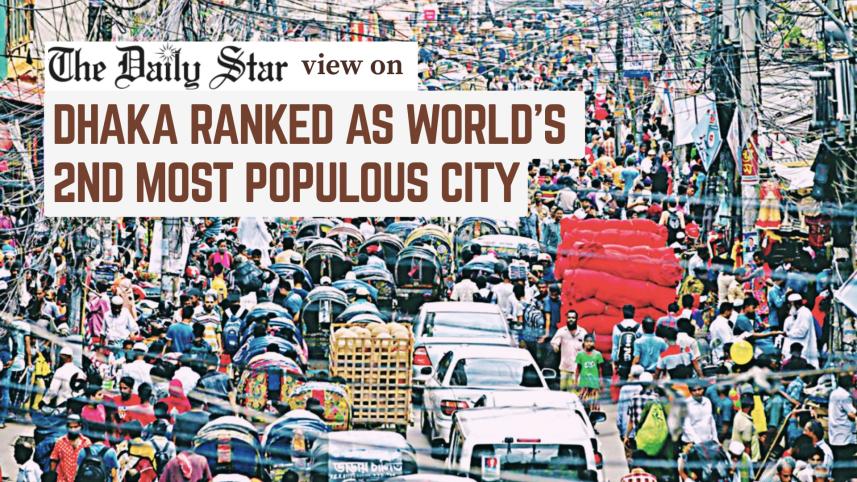
A new report by the United Nations has ranked Dhaka as the world's second most populous city after Jakarta, pushing Tokyo to third place. According to its projections, Dhaka and Shanghai are expected to experience the fastest growth among the 10 largest cities of 2025. By mid-century, Dhaka is projected to overtake Jakarta as the world's largest city, while Shanghai is expected to rise from fifth to third. It is a paradox that a city ranked third from the bottom in the Economist Intelligence Unit's Global Liveability Index 2025 continues to expand at such a pace.
The numbers are both startling and alarming, as they are almost three and a half times higher than our official estimates. The UN puts Dhaka's population at 36.6 million, whereas the Bangladesh Bureau of Statistics' 2022 Population and Housing Census records a population of just 10.2 million. This vast discrepancy is deeply concerning because population data directly influence nearly every aspect of urban planning, ranging from infrastructure and public services to the supply of essentials and economic activities.
 For all latest news, follow The Daily Star's Google News channel.
 Recent devastating fires in Kuril, Mirpur, or near the airport, along with natural hazards such as the recent series of tremors, serve as stark reminders of how overstretched our emergency and essential services have become. With severe land scarcity, Dhaka has expanded upwards in a highly unbalanced manner, resulting in grossly inadequate ratios of roads and basic civic services. The consequences are evident: traffic gridlocks lasting hours, households unable or struggling to cook for days, water rationing due to unreliable supply of safe drinking water, widespread air pollution, electricity outages causing heat-related illnesses, and an absence of many essential services. Open spaces, playgrounds, water bodies, and greenery have virtually disappeared. These shortcomings have turned Dhaka into one of the most unliveable cities in the world.
The UN report identifies faster urban population growth compared to national averages as a global trend. However, it does not account for Dhaka's exponential expansion, which is likely driven by uneven national development. Experts cite both "push" and "pull" factors. In a highly centralised governance system, the capital becomes the focal point for administrative and planning decisions, drawing people from across the country in search of opportunity. Conversely, the lack of jobs, limited economic activity, and climate vulnerability in other regions also push people towards Dhaka, resulting in a relentless flow of internal migration that overwhelms the city.
Sustainable development demands integrated planning that treats cities, towns, and rural areas as interconnected and interdependent. The UN report emphasises the need for national policies that coordinate housing, land use, mobility, and basic services across regions—measures that can ease pressure on megacities and promote a more balanced development.
In Bangladesh, past attempts at decentralisation have failed due to a lack of sincerity and commitment from political leaders and bureaucrats accustomed to the comforts of urban centrality and reluctant to relinquish them. But decentralisation is no longer optional; it has become imperative. We have reached a point where we either act to make Dhaka sustainable or prepare for the day when this unliveable megacity forces its residents to abandon it or suffer the consequences.
Comments