


Making of a mother: Discussing ‘IVF and Childlessness In Bangladesh’
What is motherhood, exactly? While biomedical sciences tell us one answer, the undeniable social experiences we gather throughout our lives say otherwise. What happens when technologies such as IVF (In-Vitro Fertilisation) allow women to surpass natural barriers to become mothers? Does it make women free from the constraints of motherhood, or does it reinforce them?
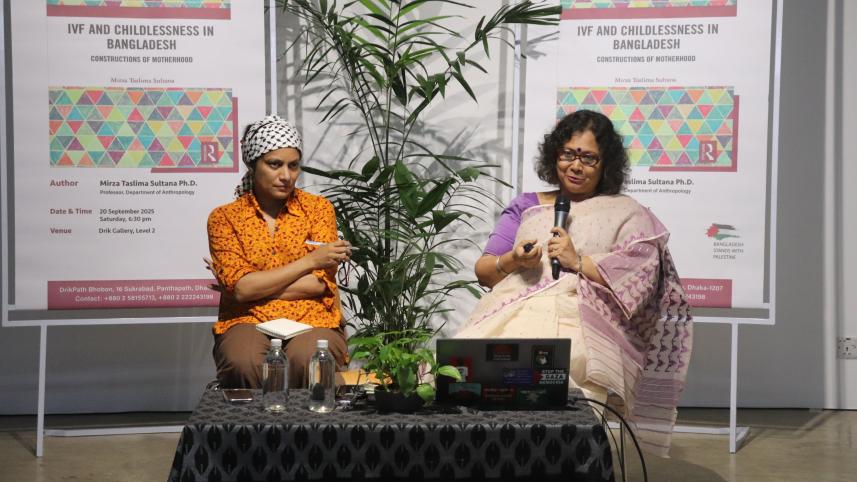
These questions and more were discussed at a book talk centred on IVF and Childlessness in Bangladesh: Constructions of Motherhood (Routledge India, 2025) by Mirza Taslima Sultana. The event was organised by Drik on September 20, 2025, with journalist Saydia Gulrukh and author Mirza Taslima Sultana on the panel.
 For all latest news, follow The Daily Star's Google News channel.
 The event began with a one-minute silence to commemorate the victims of the genocide in Gaza. Following that, host Saydia Gulrukh welcomed attendees and introduced the author before handing her the floor.
Before formally beginning, the author shared her observations about how people in Bangladesh perceive discussions about IVF. She noted that many from scientific backgrounds are often surprised that an anthropology professor would study a technology rooted in biomedical science. However, as she pointed out, sociologists and anthropologists have long examined science and technology, as these fields directly affect human lives. In the same vein, her research investigates how the introduction of IVF in Bangladesh has influenced cultural understandings of motherhood and childlessness.
She shared an anecdote from one of her interviewees, a woman who wanted to have a child even though she knew life would go on without one. "Still, I want to carry a child, in case I ever regret it," the woman had told her. This internal conflict, Sultana explained, became a key starting point for her work. In Bangladesh, she noted, motherhood remains one of the most valued identities for women, particularly married women.
Subsequent chapters in her book examine how various stakeholders perceive IVF, beginning with the media's portrayal. In the press, IVF is often framed as a miraculous solution promising happiness, reinforcing the idea that motherhood is an essential goal for women. Such portrayals also suggest that not having children leads to marital discord or social dissatisfaction.
One of the limitations of her study, the author notes, is her dependence on the experience of middle-class women, as during her research period around 2010, it was only these women who had access to IVF treatment at private hospitals.
The book also includes conversations with feminist activists such as Ayesha Khanam, Sultana Kamal, Farida Akhter, Shireen Huq, and Maleka Begum. Most of them expressed support for IVF, with Ayesha Khanam describing it as a "khirki" (window) through which light can enter—a metaphor for new possibilities for childless women. However, the activists hesitated to make IVF a national agenda, fearing conservative backlash. These debates, Sultana noted, naturally led to her interviews with policymakers. She pointed out that even after 24 years since IVF's introduction in Bangladesh, there remains no formal policy regulating it.
During the open-floor session, audience members raised questions about male participation in reproductive research and the cultural neglect of adoption, which remains overshadowed by the emphasis on biological motherhood.
Sadman Ahmed Siam, as the name suggests, is indeed a sad man. Send him happy quotes at: siamahmed09944@gmail.com.
Comments