


Taylor Swift talks back to Shakespeare
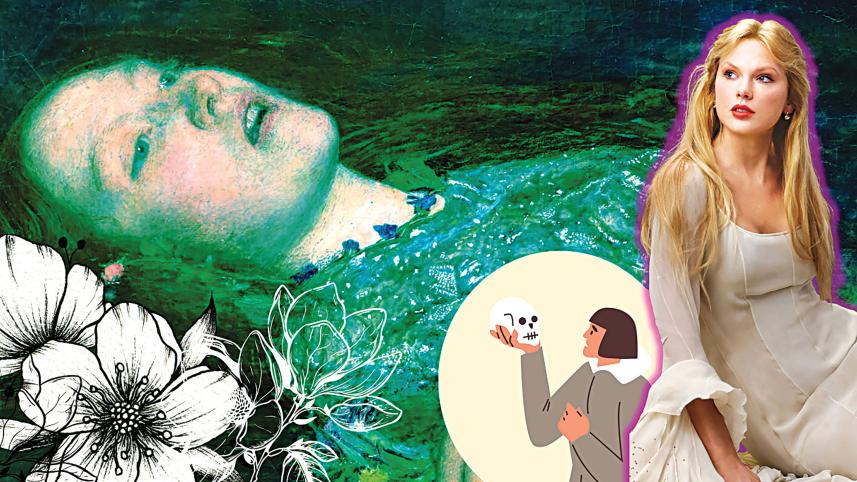
I first heard Taylor Swift's song "The Fate of Ophelia" on the radio during a road trip to New Hampshire the day after it was released on October 3. It was the opening song of Swift's latest album, The Life of a Showgirl. The song's title is a reference to the character of Ophelia from William Shakespeare's play, The Tragedy of Hamlet, the Prince of Denmark (1599-1601). It is difficult to overstate the impact that the song and the album as a whole is having in the United States. The song is ranked number 1 on the Billboard Hot 100 and broke the Spotify record for the most streamed song in a single week. Everyone—Swifties and Shakespeareans alike—started talking about the song. Fashion magazines like Elle published articles explaining the literary references in the song. One can't help but wonder what is engendering such a powerful cultural response?
"The Fate of Ophelia" isn't the first time that Swift has written about Shakespeare. She famously referenced Romeo & Juliet in her 2008 song "Love Story." It peaked at number 4 on the Billboard Hot 100, generating a far less cultural response than "The Fate of Ophelia" has produced. What is the difference? I argue that "The Fate of Ophelia" is Swift's personal talk-back to Shakespeare. It is Swift's attempt to rewrite the ending for one of Shakespeare's most tragic heroines with whom she feels a personal connection to.
 For all latest news, follow The Daily Star's Google News channel.
Swift's "The Fate of Ophelia" represents a unique dialogue between Swift and Shakespeare. Shakespeare scholars are already talking about the song. Regardless of Shakespearean opinion, Swift's song is likely to become a popular lens through which many future students approach the character. It is imperative that scholars study the song and similar adaptations to better understand this influence.
"The Fate of Ophelia" is an example of what Shakespeare scholar Martha Tuck Rozett describes as "Talking Back to Shakespeare" (1996)—a process where an artist adapts or appropriates one of Shakespeare's original works into a new collective text that often challenges the bard's original intent while still drawing upon his cultural authority.
In the 2025 Taylor Swift: The Official Release Party of a Showgirl promotional film, Swift explained her motives behind writing the song, "I love those tragedies so much. I fall in love with these characters so much that it hurts me when they die […] I'm just putting a romantic spin on the fact that Ophelia was driven mad—they drove her mad—but not me." As someone who is no stranger to heartbreak, Taylor is deeply empathetic to the character. She is not content to let Ophelia suffer what she considers an unjust fate.
In her song, Swift writes a version of herself as a foil figure to Ophelia. Unlike in Shakespeare's play where Hamlet leaves Ophelia to drown, Swift's love interest rescues her. Swift writes in the second stanza of the song, "And if you'd never come for me / I might've drowned in the melancholy[.]" The lines are a direct reference to Act 4 Scene 7 of Hamlet where Queen Gertrude describes Ophelia's offstage drowning in a local brook, "Your sister's drowned, Laertes". Swift continues this revision in the subsequent third stanza of the song when she writes, "Late one night / You dug me out of my grave and /And saved my heart from the fate of / Ophelia." Swift's lyrics echo Act 5 Scene 1 of Hamlet during Ophelia's funeral where we witness Laertes order Ophelia's corpse laid in her freshly dug grave, "Lay her in th' earth, / and from her fair unpolluted flesh, / May violets spring!".

Swift's talk-back is best visualised in the opening sequence of Swift's music video with a tableau vivant (living picture) of Swift lying on her back in a white dress on the surface of a flower-backdropped brook. The image is a recreation of the 1851 to 1852 painting Ophelia by Sir John Everett Millais of Queen Gertrude's description of Ophelia's drowning. Swift's tableau can be seen as a foil to Millais' painting. Millais' Ophelia is floating on her back looking upward singing to herself in her dirty flower strewn dress as she is already showing signs of submerging in the water. Swift's version of the character's dress remains pure white as if she remains unsullied by the dishonour and madness that stains Ophelia. Most importantly, Swift's character floats on the surface of the water completely undrowned. Unlike Ophelia, she can get up and walk away from her fate.
Swift's "The Fate of Ophelia" represents a unique dialogue between Swift and Shakespeare. Shakespeare scholars are already talking about the song. Regardless of Shakespearean opinion, Swift's song is likely to become a popular lens through which many future students approach the character. It is imperative that scholars study the song and similar adaptations to better understand this influence. The fact that artists like Swift are continuing to talk back to Shakespeare's plays offers strong proof that the bard's characters are alive and well in our cultural imagination.
Jonah Kent Richards is a Shakespeare screen adaptation scholar, an English teacher, and contributor for Star Books and Literature.
Comments