


BTRC inspection exposes gap between 4G promise and reality
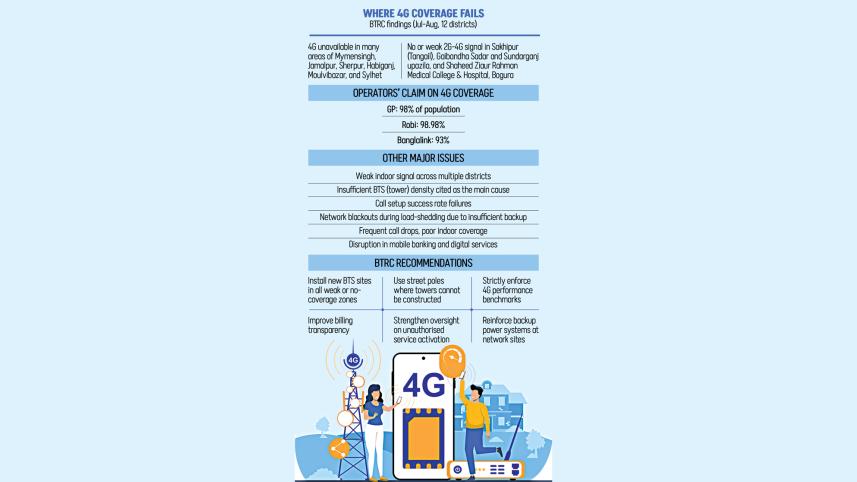
A recent inspection by the Bangladesh Telecommunication Regulatory Commission (BTRC) has exposed deficiencies in mobile network services, highlighting a gap between operators' claims of nationwide 4G coverage and the reality on the ground.
Despite operators publicly reporting 98-99 percent population coverage, persistent dead zones, weak signals and poor connectivity remain widespread.
 For all latest news, follow The Daily Star's Google News channel.
 According to the BTRC documents, four inspection teams from the Enforcement and Inspection Directorate visited remote and urban locations in Tangail, Bogura, Gaibandha, Habiganj, Moulvibazar, Sylhet, Cumilla, Noakhali, Chattogram, Mymensingh, Jamalpur, and Sherpur.
Using advanced service-quality measurement tools, the inspectors found that 4G networks were unavailable in many areas of Mymensingh, Jamalpur, Sherpur, Habiganj, Moulvibazar, and Sylhet, according to BTRC documents.
The reports noted instances of no or weak 2G and 4G signals in Tangail's Sakhipur, Gaibandha Sadar, and Kanchi Bazar, as well as at Bogura's Shaheed Ziaur Rahman Medical College and Hospital.
Inspectors further reported frequent call drops, blurred video calls and no indoor network coverage in several locations.
According to the BTRC, operators failed to meet regulatory benchmarks for 4G coverage and rollout obligations in Tangail, Bogura, and Gaibandha, violating service guidelines, licence conditions and previous directives.
Operators, however, maintain that their networks reach a wide population. Grameenphone claims 98 percent coverage, Robi 98.98 percent, and Banglalink around 93 percent.
Beyond coverage gaps, users reported difficulty accessing services indoors, while insufficient Base Transceiver Stations (BTS) – the equipment that allows mobile phones to communicate with the network – and challenging terrain, such as the hilly Teliabagar Tea Garden in Habiganj, exacerbate the problem.
Inspectors also noted call setup failures in Sylhet, particularly in tea garden areas, as well as call drops, weak indoor coverage, and complete network outages during load-shedding in Cumilla, Noakhali and Chattogram.
These issues have disrupted mobile banking and digital services, affecting students, farmers, and small traders.
The inspections found further issues, including non-compliance with Pay-As-You-Go procedures leading to unauthorised balance deductions, and complications with e-SIM services.
To address these shortcomings, the BTRC recommended installing additional BTS in weak-coverage areas, enforcing 4G rollout benchmarks with legal action for non-compliance, and improving oversight of unauthorised billing.
The regulator also suggested forming a joint monitoring cell with operator representatives to expedite resolution of customer grievances, particularly those related to billing and e-SIM services.
Taimur Rahman, chief corporate and regulatory affairs officer at Banglalink, noted that urban construction often blocks signals, and securing new tower sites is challenging as many landlords are reluctant to host them.
"To further strengthen nationwide coverage, we also need more low-band spectrum, which remains among the most expensive in the world. We are urging the regulator to reduce its cost so we can deliver better, more consistent coverage," he added.
Shahed Alam, chief corporate and regulatory officer at Robi Axiata PLC, defended the company's rollout, saying it complied fully with BTRC guidelines and that reported gaps largely relate to specific spots or buildings.
"Based on technical validation and supporting evidence, BTRC officially cleared our rollout obligations," he said.
He noted that the recent report appears to refer to specific spots or buildings. "As per regulations, operators are not obligated to ensure 4G coverage in every individual spot or structure. That said, we routinely carry out field visits and technical optimisation in such cases to enhance coverage."
The Daily Star approached Grameenphone for comment, but to no avail.
Comments