


Steel demand weak for three years

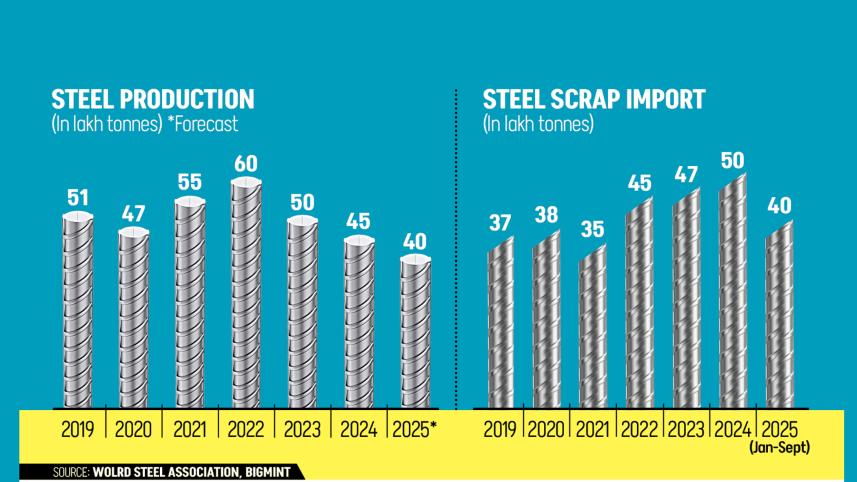
In the past three years, the steel business has been a casualty of economic and political crises, according to BigMint. The India-based market intelligence firm says demand for steel, a proxy for economic vibrancy and growth, may take two years to normalise.
Steelmakers say the timeline of the local steel industry adequately mirrors the major internal and external shocks the economy experienced in the past years.
 For all latest news, follow The Daily Star's Google News channel.
 First came Covid-19, then the Russia-Ukraine war-led disruptions to the scrap market. On the home front, a weakening taka, belt-tightening in public spending and other macro stresses added an extra layer to the situation.
The political changeover in August last year complicated the already tough conditions for steelmakers further as development spending nosedived. Meanwhile, prolonged high inflation, higher interest rates and political uncertainty dampened the real estate business and private sector construction.
Currently, the local steel industry can produce 1.36 crore tonnes per year, while demand has fallen to just 45 lakh tonnes, according to BigMint.
It says that despite the current slump, optimism persists. The World Bank, while projecting 4.8 percent economic growth in FY2025-26, said the rate may rise to 6.3 percent in FY 2026-27.
"Currently, all eyes are on the general elections in February 2026. Several infrastructure projects are in the pipeline, and the steel industry is waiting for execution to start," it adds.
By 2027, another 30 lakh tonnes of capacity is expected to be added to the overall capacity. However, industry insiders say continued investment in steelmaking without demand alignment poses significant risks.
In 2025, crude steel production is forecast to fall by 11 percent year on year, following a 10 percent drop in 2024.
Industry insiders said if this downturn continues, the sector could shrink to a handful of dominant players. Such consolidation would hurt competition and push aside the smaller mills that helped shape the industry.
Recently, one of the leading manufacturers, Abul Khair Steel (AKS), has expanded its capacity with a new plant producing 16 lakh tonnes of deformed bars annually. This has raised its total capacity to 30 lakh tonnes a year, making it the largest producer in the country.
BSRM follows with a capacity of 24 lakh tonnes. Tapan Sengupta, deputy managing director of BSRM, said, "The industry is limping along."
"Unless government spending, particularly on development projects, increases, the sector would not regain its vibrancy," he said.
Sengupta said the BigMint report accurately reflects current conditions, adding that prolonged inactivity in construction and infrastructure has taken a heavy toll on steel consumption.
Sumon Chowdhury, chairman of RRM Steel and secretary of the Bangladesh Steel Manufacturers Association (BSMA), said, "Production has been adjusted in line with market realities due to slow construction activity and liquidity constraints."
Chowdhury said these challenges are not unique to Bangladesh. Many developing economies are facing similar conditions.
He said excess capacity remains the most pressing threat. While annual capacity has reached 1.36 crore tonnes, demand has slumped to around 45 lakh tonnes, compared with 75 lakh tonnes during the peak of mega projects.
He added that if fresh investments move ahead, total capacity may climb to 1.5 crore tonnes by 2026-27, far outstripping actual demand. "Without aligning supply with demand, further investment is risky," he said.
Chowdhury said the association is working with the government and banks to stabilise raw material supplies, secure financial support and build a predictable policy environment.
Manwar Hossain, former BSMA president and chairman of Anwar Group of Industries, said the crisis began during the Covid-19 pandemic, when global scrap prices jumped from $400 to $700 per tonne but local producers could not pass on the higher costs.
"Since then, we have been under continuous pressure. The Russia-Ukraine war, shipping disruptions, and a depreciating taka have only worsened the situation," he said.
He added that political changes have further weakened demand. "Government projects, once our largest market, have virtually stopped. We have lost nearly 45 percent of that business," he said.
Hossain said many small and medium mills are shutting down as losses mount. "This could lead to an oligopolistic situation, where only four or five large players dominate. That would be detrimental to the industry's long-term health," he said.
PRICES RECORD LOW
BigMint data show that rebar prices in Dhaka have fallen to Tk 73,700 per tonne, the lowest in more than three years. Prices in Chattogram are slightly higher at Tk 77,100 per tonne.
Data from the Trading Corporation of Bangladesh (TCB) show that 60-grade steel rods were retailing between Tk 81,000 and Tk 84,000 per tonne yesterday.
Mills are now operating at only 30 to 40 percent capacity, as monsoon disruptions, import curbs and weak demand continue to bite. Credit-based sales have risen, creating cash flow pressure in a market traditionally driven by cash transactions, according to BigMint.
Steel scrap imports rose by 10 percent year-on-year to 40 lakh tonnes in the first nine months of 2025, driven by global scrap prices at a five-year low. Yet the banking crisis remains a major obstacle. Several local banks have been blacklisted by international suppliers, making it harder to open letters of credit (LCs).
Even so, industry leaders hold cautious optimism.
"We have faced tough times before," said BSMA Secretary Chowdhury.
"With stability, policy clarity, and an elected government in place, we can expect demand to return gradually, especially as foreign reserves show signs of recovery and several infrastructure projects are ready to restart," he said.
Comments