


Garment exports triple in 15 years, but jobs remain stagnant: RAPID
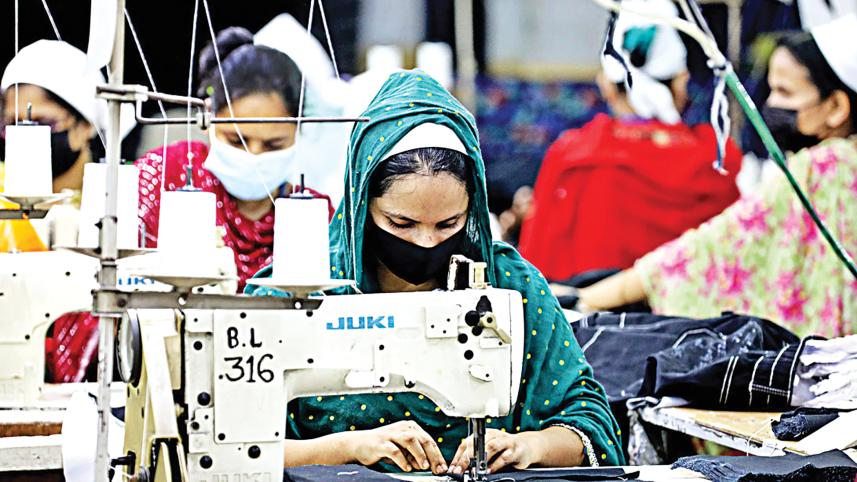
Over the past 15 years, Bangladesh's readymade garment (RMG) exports have tripled, yet job creation in the sector has remained stagnant, highlighting a growing disconnect between economic growth and employment, according to Research and Policy Integration for Development (RAPID).
The organisation also noted a decline in women's participation in the workforce during an event on the country's jobless growth, organised with Friedrich Ebert Stiftung (FES) Bangladesh at the Six Seasons Hotel in Dhaka yesterday.
 For all latest news, follow The Daily Star's Google News channel.
 Between 2010 and 2024, RMG exports rose from $12.5 billion to $40 billion, while employment in the sector stayed around 4 million, RAPID said. Its analysis showed that in 2010, 220 workers were needed for every $1 million of exports, but by 2024, this had dropped to 90.
MA Razzaque, chairman of RAPID, said the data shows that Bangladesh's growth and structural changes have not generated enough decent jobs for women and young people due to skill mismatches, widespread informality, and weak labour governance.
"This growing gap between GDP and employment could waste the country's demographic advantage," he warned.
Razzaque noted that from 2013 to 2023, agriculture's share of GDP fell from about 15.5 percent to 11 percent, while industry's share rose from roughly 25 percent to 34 percent. Despite this, manufacturing lost around 1.4 million jobs, with employment falling from 9.5 million to 8.1 million, while agriculture still employs nearly 45 percent of the workforce.
He added that manufacturing output grew 10 percent annually over the past decade, including both export-oriented garments and non-garment items for the domestic market, yet employment in the sector declined.
Women's share in manufacturing fell from around 40 percent to 24 percent, with their numbers dropping from over 3.75 million in 2013 to about 1.95 million in 2024. Between 2016 and 2020, Bangladesh created roughly 1.2 million jobs per year, far below the 2.2 million needed.
Razzaque also said that the country's long-standing protectionist regime has failed to promote diversification or employment. "Instead, it has encouraged inward-looking firms, created an anti-export bias, and caused persistent structural distortions, keeping the economy locked into a narrow industrial base," he noted.
CALLS FOR A NEW DEVELOPMENT STRATEGY
"Bangladesh's development policies have left the country structurally weak because industry, academia, and entrepreneurship are not properly connected," said Hossain Zillur Rahman, executive chairman of the Power and Participation Research Centre (PPRC) and former adviser to the Caretaker Government of Bangladesh.
"From 2016 to 2022, Bangladesh was caught in a 'triangle of vicious cycles.' Economic growth did not create enough jobs, equity was ignored by policymakers, and governance was undermined by corruption and oligarchic influence," he added.
After 2022, a series of crises worsened the situation. "Now, the country's structural weaknesses have become clearly visible," Rahman said.
"Bangladesh has often been seen as a 'resilient state' with a strong economy. But the reality is that we are now stuck in an 'unhappy resilience trap,'" he added. "Resilience has been our strength, but it no longer brings comfort. We cannot escape the cycle of crisis management."
Rahman stressed that the country needs a new growth strategy focused on employment and equity, backed by stronger governance, deeper human capital reforms, and a better understanding of labour market trends -- especially for women.
Razzaque stressed that Bangladesh's next phase of development requires a new form of state activism focused on capabilities, competitiveness, and coordination. "This includes improving product standards, supporting digital and green transitions, strengthening institutions, and implementing active labour-market interventions," he said.
He called for an employment-centred policy framework that redirects industrial, trade, and macroeconomic policies toward job creation.
"A key recommendation is that the upcoming ninth five-year plan should be explicitly designed as an employment-centred development strategy," Razzaque said. "It must be backed by adequate fiscal resources, strong coordination across ministries, and a significant strengthening of state capacity to implement coherent, capability-building reforms."
He also urged strategic industrial and trade policies that support diversification, harness digitalisation and green industrialisation for inclusive jobs, and scale up investment in human capital, skills, and the care economy.
"Gender-responsive and climate-resilient employment must be at the core of this approach," he added.
The event was chaired by Md Sanwar Jahan Bhuiyan, secretary of the Ministry of Labour and Employment. Max Tuñón, ILO country director for Bangladesh, and Saeyma Haque Bidisha, pro-vice chancellor of Dhaka University, spoke as special guests. Abu Eusuf, also a professor at Dhaka University, moderated the discussion.
Comments