


Global garment supply chain in mild slowdown over US tariff

 For all latest news, follow The Daily Star's Google News channel.
 - Tariffs, conflicts slow global garment supply
- Bangladesh faces uncertainty, buyers delay orders
- Political instability clouds investment, trade outlook
- Suppliers expand cautiously amid market slowdown
The global garment supply chain is undergoing somewhat of a slowdown due to US President Donald Trump's recent reciprocal tariffs, as well as political uncertainty in Bangladesh, according to several foreign denim apparel traders.
The rise in tariffs pushed up garment prices, leading to a fall in demand especially for denim products in the US market, which subsequently affected trade for supplier countries such as Bangladesh, China, India, Pakistan, and Vietnam.
Moreover, uncertainties remain over the Trump administration's reciprocal tariff policy for China and India, two major players in the global garment supply chain, prompting international clothing retailers and brands to adopt a "wait-and-see" approach.
In Bangladesh's case, retailers and brands are making inquiries but are not confirming bulk work orders, said the foreign companies.
Political instability is a problem in Bangladesh, and the country needs to hold elections as soon as possible, as changes are happening, said Sekip Hayit, an executive of Turkish chemical company Resas Chemie.
Buyers are waiting and not confirming all work orders now. A lot of business will come here, but not right now, he added.
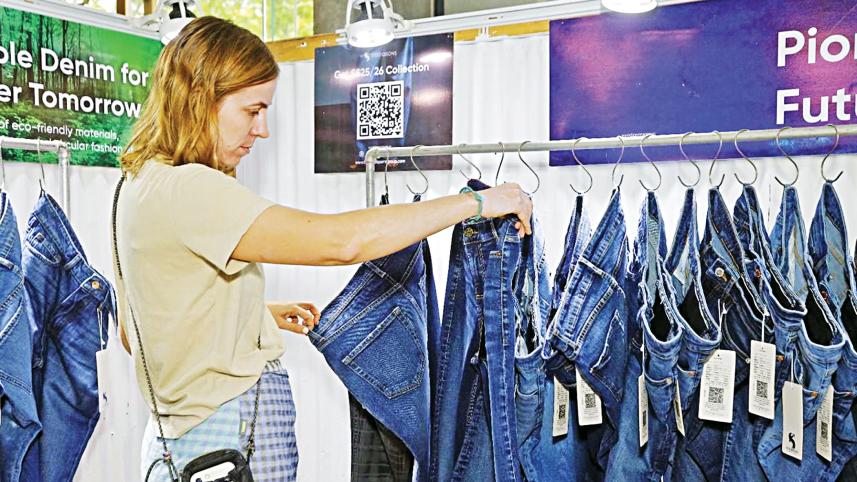
Hayit was talking to The Daily Star yesterday at the 19th edition of the Bangladesh Denim Expo, organised by its namesake company at the International Convention City Bashundhara in Dhaka. Showcasing products from 60 companies across 15 countries, the two-day fair concludes today.
The slowdown is not limited to Bangladesh but is being felt globally because of the tariffs, the Russia-Ukraine war, and the Israel-Palestine conflict, he said.
Hayit said Resas Chemie, which produces its products in Turkey, is building a textile chemical manufacturing plant in the Jamalpur Economic Zone.
Mohammad Ziaur Rahman, managing director of Resas Chemie Bangladesh Ltd, said they currently sell $24 million worth of chemicals in Bangladesh each year and are aiming to reach $35 million by the end of next year. "The market is tight now," he added.
B Hande Yildirim, sales chief of Turkish denim fabric supplier Bossa, said her company plans to set up a denim mill in Bangladesh in the future.
At present, Bossa exports about 3 percent of its four million metres of monthly fabric output to Bangladesh.
Currently, Bossa's performance here is not as good as before, said Yildirim, who has been supplying denim fabrics to Bangladesh for the past 15 years.
Stephen Hill, manager (supply chain initiatives) at Australian wool fibre supplier Woolmark, said his company has been training 60,000 farmers to improve wool production as global demand for wool products continues to rise.
Hill added that wool is increasingly being used for garment manufacturing worldwide, including in denim products. Bangladesh's wool imports are also increasing, he said.
Bangladesh imported wool products, mainly yarn and fabrics, worth $80 million in 2022, he said.
Sana Arshad, deputy general manager of Pakistani denim fabric supplier Azgard Nine Limited, said her company is performing well with its existing customers in Bangladesh, but new customer acquisition remains limited.
Her company currently ships 80,000 metres of denim fabrics a month to three or four companies in Bangladesh and expects to raise that volume to 400,000 metres in the near future.
"My market is expanding in Bangladesh. This market is fine for us, and we have been supplying denim fabrics here for the last eight to nine years," she said.
Comments