


Protect coastal homes against climate threats
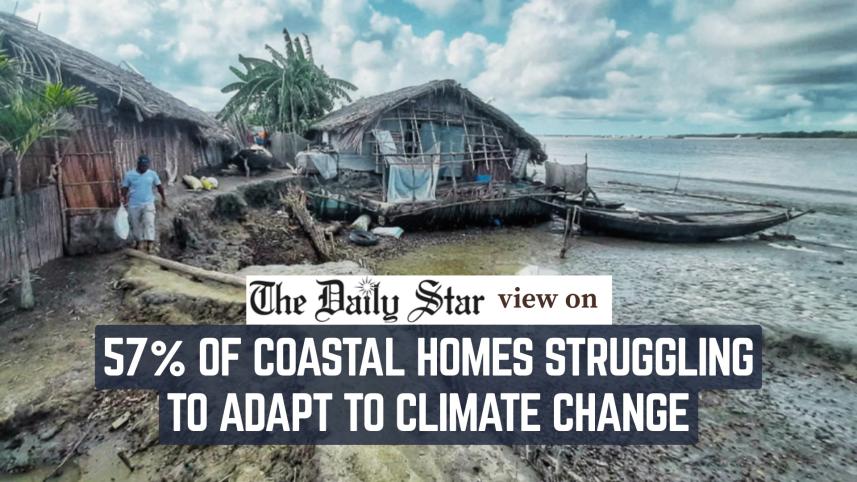
We are alarmed by the findings of a new World Bank survey that revealed that more than half of all coastal households in Bangladesh are struggling to adapt to rapid climate change due to insufficient protective infrastructure and limited financial capacity. An alarming 57 percent of surveyed households identified the lack of embankments, cyclone-resistant structures, and other protective infrastructure as the biggest long-term barrier to building climate resilience, while 56 percent cited financial hardship as a major obstacle to implementing stronger adaptation measures. These findings underscore critical weaknesses in our climate change response, leaving millions of people increasingly exposed to worsening climate shocks.
According to satellite data, coastal households experienced flooding 19 times between 2000 and 2018, roughly once a year. In the past decade, however, nearly 75 percent of coastal residents (around 90 percent based on satellite estimates) reported experiencing floods. These repeated climate shocks are depleting people's savings and making long-term recovery increasingly difficult. Moreover, poor and agriculture-dependent households, already living on the margins, are disproportionately affected as rising salinity, extreme heat, and frequent flooding erode their land, crops, and incomes. The report highlights that by 2030, nearly 90 percent of the region's population will be at risk of extreme heat, and almost a quarter will face severe flooding, demonstrating the importance of prompt action by the authorities.
 For all latest news, follow The Daily Star's Google News channel.
Reportedly, over three-quarters of households are highly aware of climate threats and anticipate a major weather-related shock within the next decade. Although many have taken adaptation measures, most have been forced to rely on low-cost, basic solutions due to limited access to advanced technologies or affordable credit. While government investments in cyclone shelters and embankments have saved countless lives in the past, fiscal constraints now limit its ability to scale up infrastructure at the speed and scope required by the climate crisis. Bangladesh reportedly needs nearly $12 billion annually for climate adaptation and mitigation, yet the government can currently provide only about $3.5 billion. This massive financing gap, combined with slow progress on climate-resilient infrastructure and delays in national planning, poses serious risks for the coming decades.
To address these challenges, Bangladesh must adopt a coordinated approach that actively engages both public and private actors. Policymakers can incentivise private investment through risk-sharing mechanisms, climate bonds, and blended finance models that link profitability with long-term social gains. Simultaneously, scaling up early-warning systems, enhancing social protection programmes, and promoting climate-smart agricultural practices will reduce vulnerability at the community level. By integrating innovative risk-financing tools with infrastructure improvements and digital connectivity, the country can create an environment where adaptation becomes financially viable.
Comments