


‘Struggle’: Noazesh Ahmed and his first masterpiece
The Nuraniganga river flowed past their house. Locals affectionately called it Nolgola. Nolgola joined the Kaliganga further downstream. The waves of Nolgola, wearing silver crests, crashed against the steps of the landing in front of the house. In the distance, rows of sailboats glided slowly across the water. The deep blue sky was dotted with cotton-like white clouds. Such beauty in the autumn air! The little box of light in his hand clicked. As far as Noazesh Ahmed can remember, this was his very first photograph. He had taken it with his elder brother Naibuddin Ahmed's Baby Brownie camera.
In the days that followed, he took many more pictures—especially of the activities of Mukul Fouz. Several of those were printed in the Mukul-er Mahfil page of the Daily Azad. And thus, in his adolescence, began his entry into the world of photography. At the time, there were two names he heard often and saw in the newspapers—Sunil Jana and Parimal Goswami. Sunil mostly photographed working-class people. Parimal captured rural Bengal, its life, nature, and landscape.
 For all latest news, follow The Daily Star's Google News channel.
 Soon came 1947. The tumult of Partition had already begun. But nature moved at its own pace. Autumn clouds drifted across the sky. Their shadows floated on the clear mirror of Nolgola's waters. Twelve-year-old Noazesh would stare in awe at the river from the steps or the window of the house. Paddle steamers and sailboats passed regularly along the river. River and boat, sky and earth, masses of clouds and their shadows—these shaped his childhood and youth.
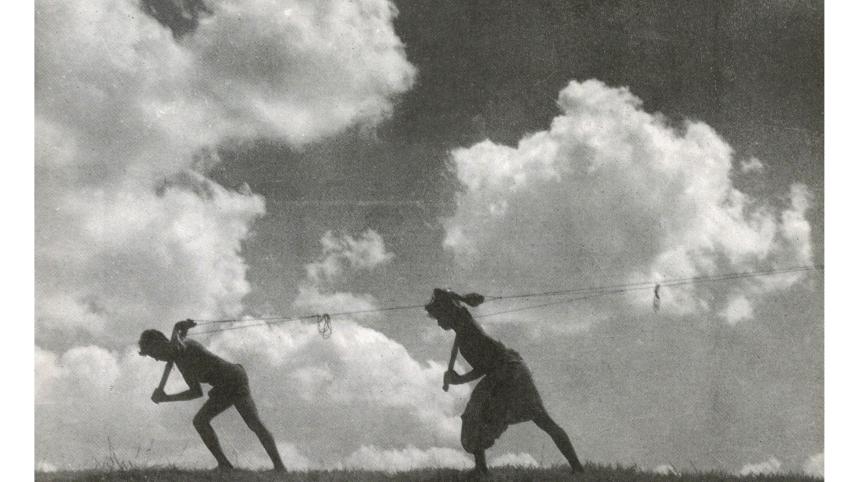
One day he saw two bare-chested boatmen hauling a boat along the riverbank with a rope. Their bodies bent forward like trees bowed by storm winds, while bright white clouds rushed in from the opposite side of the sky. He grabbed the camera and ran to the riverside. To capture the drama of the clouds, he held a piece of red cellophane in front of the Baby Brownie's fixed lens. He took several black-and-white shots. A strange thrill ran through him. Later, he hurried to Dhaka to have the film developed. The pictures looked so alive he could hardly believe they were his. He titled the photograph "Struggle".
In 1948, the Commonwealth Institute organised a photography exhibition in London. Naibuddin and Amanul Haque were sending their work by post. Seeing them, Noazesh slipped his beloved photo, Struggle, into an envelope. Somehow, it was accepted for the exhibition. The image of the rope-pulling boatmen hung on the walls of a grand British gallery. The incident filled him with tremendous inspiration.
East Pakistan Radio had a fortnightly magazine called Elan. The photograph appeared on its cover as well. Since then, the picture has been printed in so many exhibitions and publications that keeping count is nearly impossible.
Noazesh always felt that the photograph of the boatmen hauling the boat was his first serious piece of photography. He intentionally left the boat outside the frame—he feared that including it might weaken the rawness of the men's struggle. It was while taking this photograph that the idea of symbolism first entered his mind.
He had taken the photograph just before Partition. As the anti-British movement swept across India, Noazesh was a Class VII student at Manikganj Victoria High School. At the time, Mukul Fouz inspired young boys into the bratachari movement. As an active member, he became involved in these activities. During the holidays, he would return to his village, Paril Nawadha, and energise his peers in various Swadeshi efforts. His father, Najib Uddin Ahmed, was President of the Baldhara Union Board, a member of the Dhaka District Board, and an honorary magistrate. The British had honoured him with the title Khan Bahadur. Young Noazesh compelled his father to renounce that title.
Noazesh always felt that the photograph of the boatmen hauling the boat was his first serious piece of photography. He intentionally left the boat outside the frame—he feared that including it might weaken the rawness of the men's struggle. It was while taking this photograph that the idea of symbolism first entered his mind.
Camera in hand, he stood on the riverbank for some time. Boats passed by, clouds filled the sky. He waited for the moment when the clouds would move upstream. Suddenly, a cluster of clouds rushed from the opposite direction. To him, the cloud seemed to be pushing not only against the current but against nature itself. He pressed the shutter. To make the sky appear darker, he held a red cellophane sheet over the lens—a technique taught by his elder brother, who had told him, "Use red cellophane to darken a subject; use yellow to keep it lighter." From Naibuddin he inherited his love for photography. While Naibuddin shot realist and romantic images, Noazesh drifted towards the surreal.
In 1952, he enrolled at East Bengal Agricultural College (now Sher-e-Bangla Agricultural University). There he found endless stretches of green fields and tall palm trees. He now had red, blue, and yellow filters. From the verandah, he would spend hours capturing dramatic clouds with his camera. People at the college began calling him Tulot Megh and Dhulot Megh. That same year he was elected secretary of the college Language Movement Committee. The following year, at the Farmers' Fair, he organised a seven-day photography exhibition featuring works by Amanul Haque, Naibuddin, and himself. Dhaka had never seen such a large exhibition. Crowds poured in like a stream.
One day Mr Erikson, a visiting professor from Dhaka University who also edited Cultural Geography (published from Copenhagen), came to the exhibition. He needed photographs for an article on East Pakistan. The following year, six images, including Struggle, were published in Cultural Geography. Another day Mr Cleaveland, the USIS Education Officer, visited and wanted to buy some photos. Noazesh replied, "We don't sell photographs. But after the exhibition, I'll gift you a few prints." He kept his promise. A year later, it was Cleaveland who helped Noazesh secure a Fulbright Scholarship to study at the University of Oklahoma. Photography opened the door to his higher education.

He later completed his PhD at the University of Wisconsin. At one exhibition there, one of his photos won an award. Seeing it, his teacher, Nobel laureate Professor Lederberg, was deeply impressed. After class the next day, he said, "Nawa, I've seen your photograph. You have a special eye for observation. Keep it alive. Wherever you go—whether you become a professor or a research scientist—never let go of your camera."
All his life, Noazesh remained immersed in the enchantment of art. He never found time for household responsibilities; his camera was his closest companion. Through it, he wanted to reveal the beauty of Bangladesh. Presenting his homeland aesthetically was, to him, an act of devotion. In 1975, he published a photographic album titled Bangladesh. The British Geographical Society honoured it as Book of the Year. Around that time, World Bank President Robert McNamara wrote to him, "I cannot believe such a book could be produced from Bangladesh."
In April 1996, the Bangladesh Shilpakala Academy published Bastober Annesha, an album of Noazesh's work. In the introduction to the section "Five Decades of Noazesh Ahmed's Photographs", Syed Manzoorul Islam wrote:
"He began while still at school. In his very first photograph, he left the mark of his keen insight, his powerful engagement with life, and his artistic temperament. The picture titled Gunṭāna, taken at his village Paril, depicts the boatmen straining forward against the clouds—a symbol of life's struggles. Yet, through his balanced use of light and shade, that struggle acquires a layer of beauty that ennobles the hard lives of ordinary people."
In the chapter Those Awakening Days, Noazesh wrote, "The central focus of my thought is people—and the drama of their environment." In his photographs, he always tried to create a tension between mystery and truth.
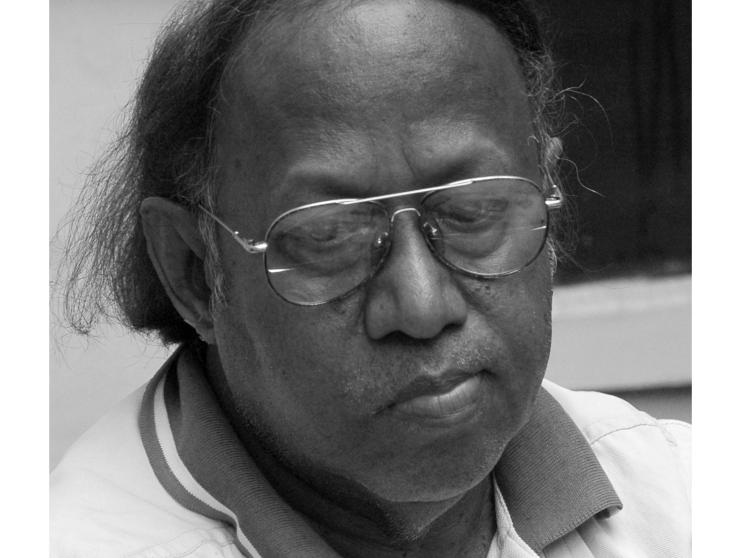
Shahadat Parvez is a photographer and researcher. The article is translated by Samia Huda.
Send your articles for Slow Reads to slowreads@thedailystar.net. Check out our submission guidelines for details.
Comments