


How to balance potato farmers’ gains with consumers’ needs
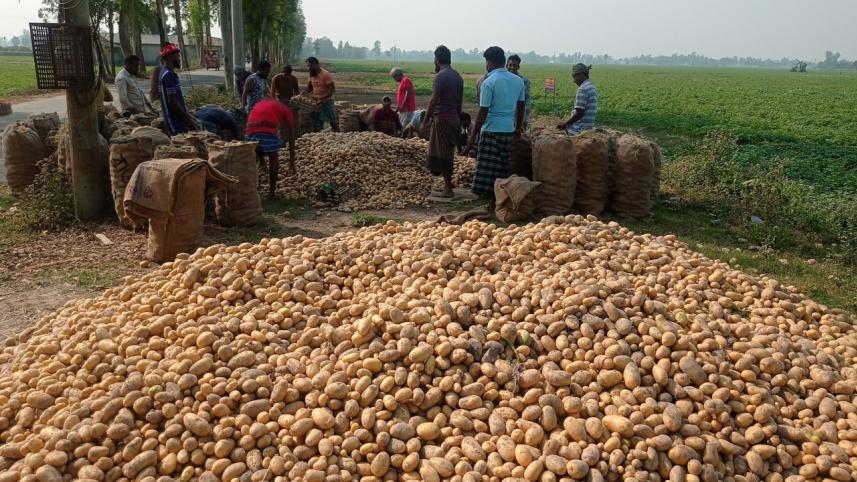
Bangladesh has experienced record-breaking potato production this year, surpassing all previous records. Bangladesh Bureau of Statistics (BBS) data shows around one crore tonnes of potato production in fiscal year 2023-24, which rose to approximately 1.15 crore tonnes in FY2024-25, an impressive 9.17 percent increase from the previous year.
But what led farmers to expand potato cultivation so significantly this year? Marginal farmers often grow crops that fetched higher prices the preceding year in the hope of more profit. There is no fault in their logic, as it is a survival strategy. In 2024, the market price of potatoes was quite high, averaging Tk 50-60 per kilogramme, which naturally encouraged farmers to expand cultivation this year. As a result, Bangladesh has recorded the highest-ever potato output in the FY2024-25.
 For all latest news, follow The Daily Star's Google News channel.
 However, this bumper harvest has brought deep concerns. The record-high production far exceeded the annual domestic demand of around 90 lakh tonnes, creating a substantial surplus and causing potato prices to plummet. Subsequently, marginal farmers suffered severe financial losses. According to news reports and local data, field production costs stand at roughly Tk 16/kg, with added cold storage costs of Tk 6-7/kg (some local cold storages in Rangpur charges Tk 400 per 60-kg sack). Yet, in local markets across the division, potatoes are being sold for only Tk 8.5-9.5/kg, resulting in significant losses. According to the Trading Corporation of Bangladesh (TCB), wholesale prices currently range from Tk 9-12/kg, while retail prices stand between Tk 15-20/kg. Over the past year, potato prices have fallen by 61-63 percent, leaving farmers struggling and the government facing challenges in managing the market surplus.
Many farmers and agricultural stakeholders have blamed the government for failing to implement previously announced measures—such as setting a minimum cold storage gate price of Tk 22/kg and procuring 50,000 tonnes of potatoes to stabilise the market. Take the case of Akhtar Mia, a potato farmer from Rangpur who cultivated potatoes on 25 acres of land this year. He reported an estimated loss of around Tk 30 lakh. He mentioned that in previous years, cold storage owners used to provide loans against stored potatoes, but this year those loans were discontinued. Moreover, when the government provides assistance, marginal farmers rarely benefit, as middlemen (mahajans) capture most of the advantages.
Evidently, potato farmers have faced substantial welfare losses this year. With prices collapsing, it is likely that many farmers will reduce potato cultivation next year, leading to lower supply and higher prices in the market. From a consumer perspective, this means people will have to buy potatoes at prices much higher than the standard market price, resulting in consumer welfare loss. This cyclical pattern of alternating farmers' and consumers' welfare losses has been recurring in Bangladesh's potato market in recent years. So, the key question arises: how can Bangladesh simultaneously protect both farmers' and consumers' welfare, where one group's gain does not come at the expense of another? To achieve this, effective government intervention is essential.
The Department of Agricultural Extension (DAE) maintains data on how much land in each upazila is allocated to various crops. By analysing domestic demand and the export volume of potatoes, the DAE can predict how much land should ideally be used for potato cultivation each year. A cultivation limit could be introduced to prevent farmers from allocating excessive land to potatoes alone. Encouraging farmers to diversify into other crops would promote crop diversification, improve soil fertility, and enhance food security. Bangladesh spends a significant amount on importing food grains every year. If farmers shift towards producing a balanced mix of crops suited to local soil fertility—rather than focusing excessively on a few profitable crops—the country could save valuable foreign exchange and move towards food self-sufficiency. Although such a policy may involve high monitoring costs, it would be highly effective and sustainable for the economy in the long run, provided it is implemented with integrity and strict oversight.
If Bangladesh consistently produces potatoes beyond domestic demand, it must identify and develop new export markets. Despite being the seventh-largest potato producer in the world, according to the Food and Agriculture Organization (FAO), Bangladesh does not rank among the top 20 exporters. According to the Export Promotion Bureau (EPB), Bangladesh currently exports potatoes to 14 countries, including Singapore, Nepal, Sri Lanka, Malaysia, and several Middle Eastern nations. Compared to FY2021-22, exports dropped significantly in FY2022-23 and FY2023-24 due to strong domestic demand. With record-breaking production in FY2024-25, exports increased again by a significant margin compared to the previous year. The Middle East offers immense potential for expansion. Signing Free Trade Agreements (FTAs) with Middle Eastern countries could enable duty-free exports, opening new markets and boosting export volumes. Moreover, developing transportation infrastructure would significantly reduce export costs. The North Bengal region, a key potato production hub, currently takes two days for goods to reach Chattogram port via Dhaka, increasing both time and costs. Establishing a direct railway route from North Bengal to Chattogram would enable faster and cheaper exports, helping Bangladesh compete more effectively in the global market.
The Rangpur division, especially the char areas, produces large volumes of potatoes and has an abundance of low-cost labour. This provides a comparative advantage for developing agro-processing industries, particularly in potato-based products such as chips and French fries. Setting up international-standard processing facilities in Rangpur could not only increase exports but also generate employment for flood-affected and low-income communities, contributing significantly to Bangladesh's GDP. For example, PepsiCo began producing Lay's chips in Bangladesh in 2023, some of which are already being exported abroad. If the government reduces supply-side constraints and improves infrastructure, the cost of doing business will fall, attracting more foreign investment in the chips industry and boosting exports.
However, Bangladeshi potatoes have relatively low dry matter content, making them less crispy and less energy-efficient for chip production. The government should consider importing high-dry-matter potato seeds suitable for chip and French fry production and supplying them to farmers. This would enhance the country's competitiveness in the processed potato industry and create a sustainable export market.
Md Razib is research associate at the South Asian Network on Economic Modelling (SANEM). He can be reached at mdrazib329@gmail.com.
Views expressed in this article are the author's own.
Follow The Daily Star Opinion on Facebook for the latest opinions, commentaries, and analyses by experts and professionals. To contribute your article or letter to The Daily Star Opinion, see our guidelines for submission.
Comments