


The president and the professor
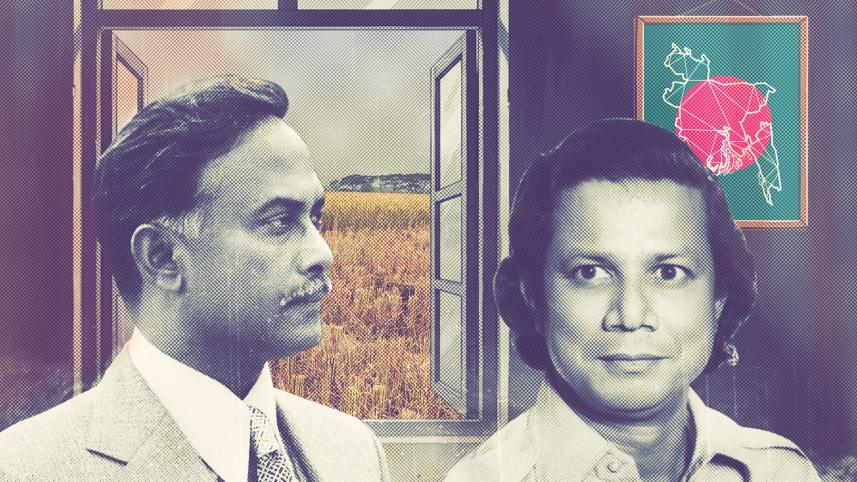
Good ideas can emerge from anywhere and anyone. Confident political leaders search for the best ideas and embrace those. Politics should not get in the way. This is an important lesson for politicians in Bangladesh today, as we are busy preparing for the forthcoming democratic elections. Instead of emphasising "ideology," the politicians should campaign on "good ideas."
Academics often complain that politicians are either unaware of their research and policy recommendations or simply ignore their work. Perhaps we, the "armchair" academics, should contemplate our own modus operandi to understand why our ideas lack credibility and are ignored by those in power. Our research must go beyond the knowledge and theories learned from textbooks written by experts who may never have visited Bangladesh, let alone lived in a village.
 For all latest news, follow The Daily Star's Google News channel.
 This article describes a few episodes from Bangladesh's history that illustrate how an interested political leader, President Ziaur Rahman, reached out to an academic, Muhammad Yunus, producing positive results for the nation. The president took this extraordinary step because the professor had earned credibility through his field work, living and working in villages, as part of his "action research" agenda on poverty alleviation.
After the great famine of 1974, which claimed more than a million lives, Prof Yunus became increasingly involved in rural development efforts. In 1975, he developed the "Nabajug Tebhaga Khamar" (New Era Three-Share Farm) project, a real-world action-research initiative to increase farm productivity. Given the success of this innovative project, he received the prestigious President's Award in 1978. The BNP government under Zia adopted and scaled up core elements of this programme, renaming it the Packaged Input Programme (PIP). Unfortunately, the nationwide scale-up was not as successful, since it was made mandatory.
The award elevated Professor Yunus's profile both on campus and nationally. Consequently, a professional relationship developed between the two, with President Zia often seeking Yunus's ideas and feedback on his own rural development initiatives. The two corresponded and even partnered on a few projects aimed at rural development.
To enhance the effectiveness of rural development efforts, Dr Yunus had proposed the idea of village governance called "Gram Sarkar," to empower local communities to take initiatives for their own progress and prosperity.
President Zia's government formally adopted this concept, leading to the formation of over 40,000 village governments (implemented during Khaleda Zia's 2001-2006 government), serving as a fourth tier of government. A key difference, which rendered the nation-wide programme less effective, was its mandatory nature as opposed to Yunus's initiative, which was voluntary.
Alex Counts, the author of Small Loans, Big Dreams: Muhammad Yunus, Grameen Bank and the Global Microfinance Revolution, (2025 edition), cites several instances when the two men interacted in the late 1970s.
Counts writes on these two programmes:
"While he was working to establish his ideas at the local level, Yunus continued to be involved with national political figures. He had a warmer and more complex relationship with President Zia Ur Rahman than he'd had with Sheikh Mujib. The two had first come into contact in 1977 when Yunus received the President's Award on behalf of the Tehbhaga Khamar project. On several occasions, Zia called on Yunus as a representative of the younger generation of academics to speak out on subjects ranging from the wisdom of conducting state planning on two-year cycles (rather than the traditional five) to the proposal for beginning to transmit television signals in color instead of black and white..." (Counts, page 51)
…After taking over, Zia discussed the matter with Yunus and indicated that he, with the help of Mahabub Alam Chashee, intended to implement gram sorkar nationwide. Many Bangladeshi intellectuals were outraged that the proposal was being taken seriously, perhaps because on some level it valued the knowledge of semiliterate villagers more than theirs. (Counts, page 31)"
It should be noted that though Grameen Bank was formally established as an independent financial institution in 1983, after Zia's death, the idea for this unique bank originated in 1976 from a microcredit research project of Prof Yunus.
The story of partnership and collaboration between the Zia and Yunus offers valuable lessons for future politicians. It is rare for a head of state to take such a personal interest in an issue—rural development in this case—spending significant amount of time visiting villages to understand villagers' problems and inspiring them to work hard to escape poverty. Secondly, it is uncommon for a young academic to be so influential that the head of state would be impressed by his ideas and work in the field, to the extent of adopting and scaling them up nationally.
In 1975, Yunus was a 35-year-old academic with a degree from Vanderbilt University in the United States, teaching economics at Chittagong University (CU). He frequently visited villages near the CU campus to learn about the lives of both men and women. He called his approach "action research," involving colleagues and students who shared his passion for this work. His colleague, Prof H I Latifee, recently shared with me that, when HYV, the high yield variety of rice, was newly introduced, the farmers were somewhat reluctant to adopt it. "We would sometimes get into the field ourselves to demonstrate how to plant the saplings in straight lines," he said.
Clearly, Dr Yunus was not your typical academic. Most young professors early in their career are interested in securing research grants, recruiting students to collect data, either in the field or from secondary sources, running regressions on computers, and writing scholarly articles for publication, which is considered the "gold standard" for academic success. These publications carry great weight in terms of tenure and promotion. However, they are normally of little immediate practical benefit for farmers and the impoverished villagers, who are often the subject of academics' research.
In his book, Counts mentions several interactions between Zia and Yunus:
"On that hot Friday in April, Yunus followed Zia and his entourage for seven miles. On two occasions, he listened to the president's speeches, and both times Zia made sure that Yunus was sitting next to him when he delivered his remarks…
…Soon after Yunus left Zia so that he could unwind, presidential assistants came running in search of him. He was told that the president wanted to speak to him. When Yunus, still drenched with sweat from the walking, entered the room where Zia was resting, he was ushered into a chair by the president's bedside. Zia looked up at his guest and said, 'So, what did you think?'
Taken aback, Yunus innocently asked, 'About what?'
'About my speech.'
Measuring his words carefully, Yunus said: 'Well, I think people were very inspired to hear from you.' He paused, and then continued: 'But there is one thing I would have changed. You see, people are talking about how bad this drought is, but I saw a lot of water in the river we passed over in the helicopter. If some of that water was diverted to the fields by canals or even lifted by hand, then we would be seeing some green fields instead of brown ones. And that's something people can do right now. What I'm trying to say, Mr. President, is that in your speech you kept telling people what you are going to do for them. I think it would be much more useful if you talked about what they could do for themselves." (Counts, page: 52-53)
To summarise, good-to-great ideas are essential for a nation's growth and prosperity. As Bangladesh moves towards the 2026 elections, the benefits of partnership between politicians and researchers must not be lost on the next elected government for the nation to move forward.
Munir Quddus serves as an endowed professor of economics at Prairie View A&M University near Houston, US. He can be reached at muquddus@pvamu.edu
Views expressed in this article are the author's own.
Follow The Daily Star Opinion on Facebook for the latest opinions, commentaries, and analyses by experts and professionals. To contribute your article or letter to The Daily Star Opinion, see our guidelines for submission.
Comments