


BNP’s notes of dissent show that old habits die hard


A cursory examination of the July National Charter reveals that BNP's notes of dissent—and those of its axis of like-minded parties—follow a certain pattern. Many of the 84 proposals in the charter can be carried out with simple executive orders. However, there are some that require constitutional amendments, while others demand new laws. Taken together, BNP's position throughout the discussions at the National Consensus Commission shows a consistent opposition to proposals that would significantly weaken the authority of the prime minister or the ruling party in running the government.
It is important to point out that almost 30 proposals have accompanying notes of dissent. Of them, BNP filed over a dozen notes, while Jamaat-e-Islami had only one and the NCP had none. The charter records several instances of both BNP and Jamaat disagreeing with certain proposals but not strongly enough to formalise them as notes of dissent. It should also be noted that both Jamaat and NCP approached the discussions on reforms as potential opposition parties in a future parliament, and hence their interest in strengthening accountability mechanisms of the government, which coincided with the public interest as well.
 For all latest news, follow The Daily Star's Google News channel.
 Let us begin with the proposal for a 10-year term limit for a prime minister and the bar on individuals simultaneously serving as party leader and PM.
Initially, the proposal was to bar individuals from serving as prime minister for more than two terms. BNP opposed this and finally agreed to a 10-year limit—on the condition that another key proposal, the National Constitutional Council (NCC), be dropped entirely. The initial draft also proposed that MPs would be allowed to hold only one of three positions—prime minister, party chief, or leader of the parliamentary party. The final draft dropped the third role, simply mentioning that MPs would be barred from serving as both PM and party chief at the same time. BNP dissented to that proposal as well.

Let us take a moment to analyse what this really means. First, the National Constitutional Council. It was proposed as an independent body—comprising representatives from the ruling party, the opposition, other political parties, the president, and the chief justice—for making appointments to key constitutional and regulatory bodies such as the Anti-Corruption Commission (ACC), Election Commission, Bangladesh Bank, Comptroller and Auditor General (CAG), the chiefs of the armed forces, and most importantly, the head of the caretaker government.
The provision was designed so that successful appointments would require bipartisan support, making candidates more broadly acceptable. But BNP opposed this and successfully bargained to have it removed, trading it off against the 10-year PM term limit.
Notably, the term limit is 10 years, not two terms—a distinction that warrants some scrutiny. While the difference here may seem minor, one could argue that a future ruling party might delay constitutionalising the provision until late in its tenure, thus allowing a sitting PM to serve nearly a full term before the clock starts ticking. Technically, then, the PM would clock a few months, maybe a year, at the helm, thus affording them a clear run for, say, nine more years (or almost two further terms). That is presumably the advantage of a 10-year limit over a two-term one.
BNP has dissented to proposals that strengthen government accountability, ensure the independence of constitutional bodies, and prevent excessive concentration of power in the hands of the prime minister. Further, it has opposed provisions aimed at making constitutional amendments bipartisan. Its stance on Article 70 also indicates a desire to retain tight party control over parliamentary votes, paving the way for the kind of majoritarian governance that has repeatedly undermined democratic practice in Bangladesh.
Then there are the appointments to constitutional bodies—the ombudsperson, the Public Service Commission, the CAG, or the ACC. If these institutions were made truly independent and free from political influence, they would strengthen transparency and accountability. The charter proposed an independent body for these appointments, but BNP and its allies submitted notes of dissent against it.
Another widely supported proposal was the introduction of an upper house of parliament based on proportional representation of votes acquired in the general election. Read that in connection with the proposal that constitutional amendments would require a two-thirds majority in both houses of parliament. This would mean that even if a party secured two-thirds of seats in the lower house (meaning 200 out of 300 seats, or 67 percent) and wanted to amend the constitution, it would require opposition support in the upper house whose composition could be different because of the proportional representation of votes. In other words, any amendments pushed by the ruling party would have to be so necessary and justified that even the opposition, or at least some of its members, would find merit in them.
But BNP has done its best to dilute this proposition, beginning with its suggestion that the upper house be constituted according to the proportion of seats won by parties in the lower house, and not by their share of votes—making it a mirror image of the lower house where the ruling party would again dominate. BNP has also added a proviso, through another note of dissent, that the upper house should have no say in constitutional amendments.
This stance has to be considered alongside BNP's proposal for exceptions of Article 70 of the constitution, which barred MPs from voting against their party line. There was general agreement that it should be done away with, except in finance bills and votes of no confidence. BNP's note of dissent, however, proposed that the exception should not apply to constitutional amendments, meaning that MPs would still be barred from voting independently on constitutional amendments.
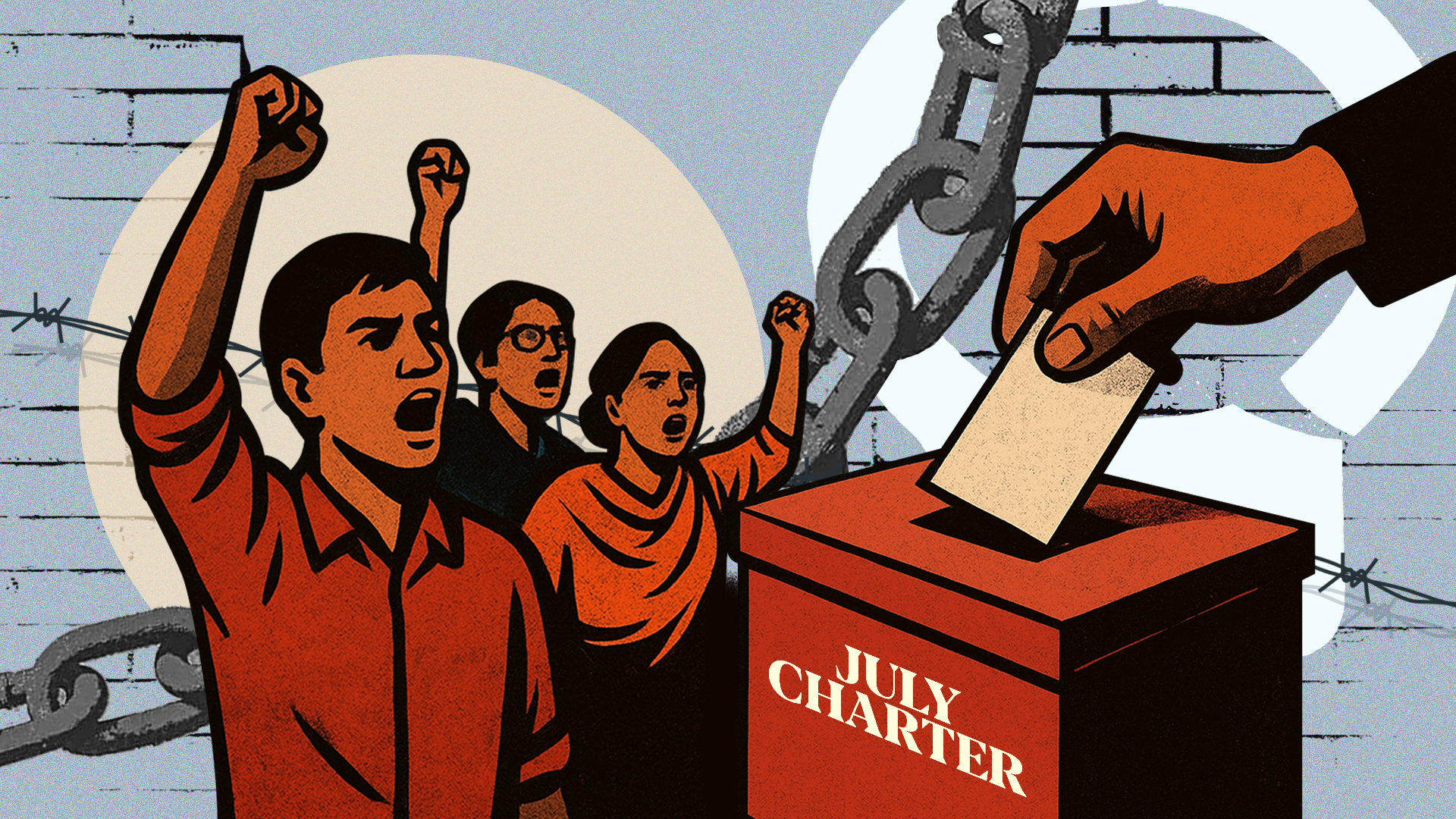
The pattern that emerges from these positions is clear: BNP has dissented to proposals that strengthen government accountability, ensure the independence of constitutional bodies, and prevent excessive concentration of power in the hands of the prime minister. Further, it has opposed provisions aimed at making constitutional amendments bipartisan. Its stance on Article 70 also indicates a desire to retain tight party control over parliamentary votes, paving the way for the kind of majoritarian governance that has repeatedly undermined democratic practice in Bangladesh.
BNP's approach at the consensus commission discussions seems to have been guided by the assumption that it will win the next election and form government with a considerable majority. What was meant to be a collective effort to build a stronger, more accountable system of governance for citizens has thus turned into an exercise in expedience. BNP, from these developments, seems intent less on ensuring checks and balances than on preserving the latitude to govern without them.
Tanim Ahmed is digital editor at The Daily Star.
Views expressed in this article are the author's own.
Follow The Daily Star Opinion on Facebook for the latest opinions, commentaries and analyses by experts and professionals. To contribute your article or letter to The Daily Star Opinion, see our guidelines for submission.
Comments